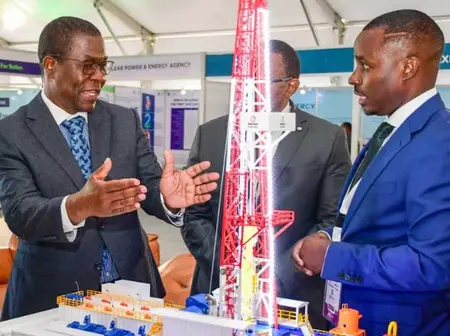
Wandayi made the commitment on Thursday, November 26, while addressing the opening of the 2026 Sustainable Energy Conference (SEC) in Olkaria, Nakuru County.
He said the government would work with the Energy and Petroleum Regulatory Authority (EPRA) to strengthen regulations governing electricity tariffs, licensing and power purchase agreements.
The CS explained that attracting private investors into the energy sector remained important, but their interests would have to be balanced against the need to keep electricity affordable for ordinary households and businesses.
Wandayi maintained that the government was committed to creating a predictable investment environment while ensuring Kenyans were not subjected to unreasonable electricity costs.
"The Government will continue to protect consumers from unreasonable costs. Our task is to strike the right balance, so that power is affordable for Kenyans and investment is rewarding for those who build it," he said.
His remarks come as Kenya experiences increasing electricity demand, putting pressure on the country to expand generation capacity and strengthen its transmission network.
According to figures presented at the conference, national peak electricity demand reached approximately 2,550 megawatts in July 2026, marking a record high.
The CS said the rising demand reflected the country's expanding economy and the need to invest in infrastructure capable of supporting future industrial and household consumption.
He cautioned that building additional power plants without corresponding transmission infrastructure would limit the amount of electricity delivered to consumers.
"A power plant without adequate transmission infrastructure is constrained in delivering its full generation capacity, while a transmission line with insufficient generation remains underutilised," Wandayi explained.
Wandayi also highlighted Kenya's progress in renewable energy, revealing that approximately 90% of the country's electricity comes from renewable sources.
The sources include geothermal, hydroelectric, wind and solar power.
He attributed this achievement to sustained cooperation between the government and private investors, including the Kenya Electricity Generating Company (KenGen), the Geothermal Development Company (GDC) and independent power producers.
Kenya has established itself as one of the world's leading geothermal energy producers, with geothermal power playing a significant role in supplying electricity to the national grid.
However, Wandayi argued that maintaining this progress would require additional investment, particularly in energy storage and electricity transmission.
He urged private investors to consider financing battery storage systems, which would help the country store electricity generated from renewable sources and release it when demand rises.
Such systems could improve the reliability of solar and wind power, whose production depends on weather conditions.
The Energy CS further reaffirmed the government's commitment to expanding electricity access, describing universal connectivity as a priority that could not be compromised.
He cited Kenya's participation in Mission 300, a joint initiative by the World Bank and the African Development Bank seeking to connect 300 million people across Africa to electricity by 2030.
Kenya's commitments under the programme are outlined in its National Energy Compact.
Wandayi also highlighted the importance of regional electricity cooperation, pointing to existing power interconnections with Ethiopia, Uganda and Tanzania.
He said continued collaboration through the Eastern Africa Power Pool would help develop a wider regional electricity market, allowing participating countries to improve power supply and benefit from available energy resources.
The CS also urged county governments to complete their respective energy plans as required under the Energy Act.
The conference, organised by KenGen under the theme Powering Africa's Green Industrial Revolution, brought together energy stakeholders to discuss investment opportunities, renewable energy development and the infrastructure needed to support Africa's growing electricity needs.
Source
Leave a Reply