Human waste is commonly associated with filth, unpleasant odours and the risk of disease.
Its disposal is often a major sanitation challenge, particularly in urban areas where poor waste management can expose communities to disease-causing microorganisms.
But in Busia county, what households, hotels and institutions flush away does not necessarily end up at a dumping site. Instead, it is given a second life on farms through an innovative circular sanitation model that links urban waste management to agricultural production.
The Busia Faecal Sludge Treatment Plant (FSTP) project is addressing the challenges of poor waste disposal, declining soil fertility and food insecurity by transforming human waste into organic fertiliser.
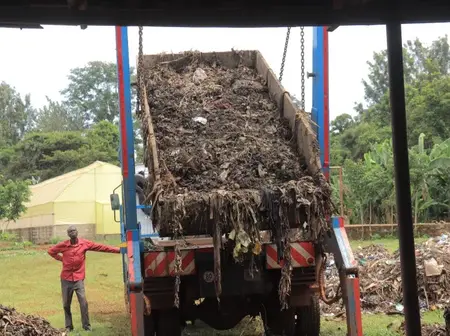
The initiative collects faecal sludge from across Busia town, alongside biodegradable waste from markets and other public spaces. The materials undergo treatment before being combined through a process known as co-composting to produce organic manure for agricultural use.
The process is carefully controlled. Faecal sludge passes through treatment beds, while vetiver grass is used to absorb heavy metals such as mercury.
Market waste is sorted to remove plastics, while bottles are reused to plant seedlings. The biodegradable material is then shredded and mixed with treated sludge.
Through windrow composting, the mixture gradually decomposes into dark, nutrient-rich co-compost that can be applied to agricultural land.
The initiative challenges conventional approaches to sanitation by treating waste as a resource rather than a disposal problem.
Implemented at the Busia Agricultural Training Centre (ATC), the project is a partnership involving FINISH Mondial Kenya, the County Government of Busia, Busia Water and Sewerage Services Company, and non-governmental organisation WASTE.
Norman Shisia, a driver with Busia Water and Sanitation Company, said some of the waste was previously taken directly to farms, raising concerns about environmental safety.
“We are grateful for this project because, previously, this waste was being taken to people's farms. Now, for the sake of cleanliness in Busia, it is collected and brought here so that the project can process it and turn it into fertiliser,” he said.
For Shisia, the benefits go beyond improved sanitation. The two-year-old initiative has established an organised waste collection system, supported business opportunities and provided an alternative source of fertiliser for agricultural production.
Moses Otieno, who manages the project, said it was conceived after the team identified gaps in municipal waste management and the limited availability of affordable organic fertiliser for farmers.
“We came up with this project so that we can recover resources out of that waste,” he said.
Otieno said the plant receives between 15 and 20 tonnes of municipal solid waste and approximately 90,000 litres of liquid waste from the municipality every week.
It has the capacity to produce between 10 and 15 tonnes of fully decomposed co-compost manure every month.
He said the facility had treated and transformed 997 tonnes of human waste during its first two years of operation.
“The resulting co-compost has undergone trials on different crops during both the long and short rain seasons. Certification is underway ahead of commercial distribution,” he said.
The fertiliser is already being used by some farmers seeking alternatives to conventional agricultural inputs.
Eric Ekesa of Wezesha Agro Eco Hub said his organisation practises sustainable and regenerative agriculture.
It uses the organic fertiliser to grow vegetables through kitchen gardens, vertical gardens and other small-scale farming techniques.
“Organic fertiliser helps the soil to retain moisture, potentially reducing nutrient loss through runoff during rainfall and helping limit soil erosion. These benefits are particularly relevant as farmers contend with changing weather patterns, unpredictable rainfall and deteriorating soil conditions,” he said.
Ekesa said the decision to adopt the fertiliser was informed by the need to improve soil health and reduce dependence on conventional agricultural inputs.
“We have decided to embrace regenerative and sustainable agriculture by using locally produced organic fertiliser made through the FINISH Mondial initiative, to preserve and maintain soil health,” he said.
By producing organic manure, the facility offers farmers an alternative source of soil nutrients while supporting efforts to improve soil health and reduce reliance on conventional chemical inputs.
At the Busia ATC, the compost has also been incorporated into crop production. It is being used to demonstrate farming technologies that small-scale farmers can adopt.
Centre farm manager Gabriel Nyongesa said restoring soil fertility was an important part of responding to climate-related agricultural challenges.
He said soils that had been cultivated for generations had gradually lost their fertility, making organic manure an important intervention in restoring their productive capacity.
“We are also using organic manure as an intervention to address climate change and declining soil fertility. Our soils have been cultivated for generations, and their fertility has gradually deteriorated,” he said.
Nyongesa added that the manure helped improve soil fertility and increase crop production per unit area.
Leave a Reply