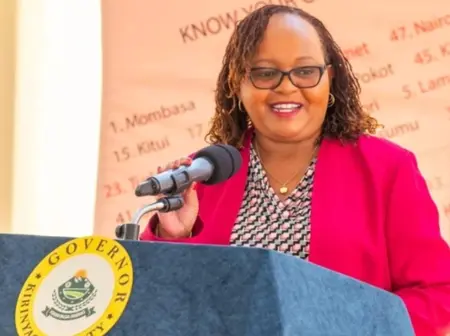
Kirinyaga Governor Anne Waiguru has called on county governments to reject directives from the Ministry of Health that violate the constitutional framework governing devolution, escalating the dispute over the management of public healthcare facilities.
Waiguru argued that the national government cannot make unilateral decisions affecting county-managed health institutions without consulting the respective county administrations.
She made the remarks on Wednesday, November 25, 2026, while addressing County Executive Committee Members (CECMs) for Health during a quarterly consultative meeting held in Kagio, Kirinyaga County.
The governor's statement comes amid growing disagreement between the national and county governments over a directive issued by Principal Secretary for Medical Services Ouma Oluga.
Oluga had instructed Social Health Authority (SHA) compliance officers to remove payment paybills from public health facilities, a move that has raised concerns among county leaders.
Waiguru questioned the manner in which the directive was communicated, maintaining that healthcare management falls under devolved functions and that counties must be involved in decisions affecting their institutions.
She called on the Ministry of Health to follow established intergovernmental consultation procedures when issuing policies or instructions that affect county health services.
The governor also challenged county health executives to protect their constitutional responsibilities instead of implementing orders that could undermine the authority of county governments.
The proposed removal of hospital paybills has emerged as a major point of disagreement between the two levels of government.
Council of Governors Chief Executive Officer Mary Mwiti also expressed reservations about the directive, warning that eliminating alternative payment channels could inconvenience patients seeking medical services not covered by SHA.
Mwiti noted that some patients still depend on cash payments when accessing certain services, making alternative payment arrangements necessary in public hospitals.
She urged health sector officials to consider their respective constitutional responsibilities and assess the practical consequences of directives before implementing them.
Waiguru further observed that the success of the transition to SHA would depend on reliable funding, timely hospital reimbursements and efficient processing of medical claims.
She called for greater transparency in the distribution of healthcare funds, insisting that counties should clearly understand how resources would be allocated and disbursed to their facilities.
The governor cautioned against funding arrangements that could leave some counties disadvantaged because of unclear requirements or conditions that are difficult to meet.
She also maintained that healthcare financing should reflect the unique circumstances and priorities of individual counties.
Using Kirinyaga as an example, Waiguru pointed to the county's irrigation-based agricultural activities and the associated malaria burden, arguing that local health challenges should influence resource allocation.
Away from the disagreement with the Health Ministry, the Kirinyaga governor defended the progress made in the healthcare sector since the introduction of devolution in 2013.
According to figures she presented, the number of operational health facilities across the country has increased from 8,466 in 2013 to 14,710.
She attributed part of the expansion to county governments, which constructed 1,419 dispensaries and health centres during the first five years of devolved administration.
Waiguru further noted that county governments employ approximately two-thirds of Kenya's health workforce.
She also highlighted the contribution of 107,831 Community Health Promoters who provide primary healthcare services at household level.
The governor said devolution had helped bring specialised medical services closer to residents who previously had to travel to Nairobi and other major referral centres.
These services include dialysis, cancer treatment, intensive care and advanced medical imaging, supported by cooperation between national and county governments.
Waiguru also outlined improvements recorded in Kirinyaga's healthcare system, particularly in maternal and newborn health services.
She said maternal mortality in the county had declined from 88 deaths per 100,000 live births in 2017 to 49 in 2025.
Neonatal mortality also dropped from 26 to 11 deaths per 1,000 live births during the same period.
The governor revealed that bed capacity at Kerugoya County Referral Hospital had expanded from 220 to 450 beds.
Additionally, the number of public health facilities in Kirinyaga had increased from 63 to 76.
The meeting also marked the first anniversary of the County Inter-MPDSR initiative, which focuses on strengthening the monitoring and response to maternal and perinatal deaths.
With the 2027 General Election approaching, Waiguru urged county health executives to put measures in place to protect ongoing healthcare programmes during changes in county leadership.
She called for proper documentation of existing projects, achievements and pending commitments to ensure incoming administrations can continue implementing established programmes.
The governor maintained that healthcare performance should not be judged solely by the number of facilities constructed but also by improvements in service delivery, quality of care and public confidence.
The consultative meeting brought together county health executives and other stakeholders to review progress in Universal Health Coverage, examine challenges facing devolved healthcare and discuss ways of improving medical services across the country.
https://www.facebook.com/100063646850476/posts/1762890189175859/?app=fbl
Leave a Reply