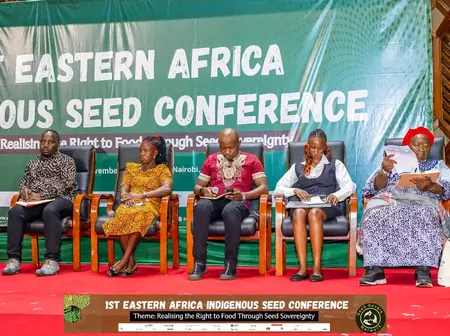
The call was made during the first East Africa Indigenous Seed Conference, where participants highlighted the importance of preserving traditional seed systems, protecting farmers' rights and promoting policies that support sustainable agriculture.
Speaking on the sidelines of the conference, Judy Nyokabi, Happy Family Captain, emphasised the need to preserve indigenous maize varieties and pass traditional agricultural knowledge to future generations.
Nyokabi said indigenous maize varieties were particularly important because of their ability to withstand long-term storage, adapt to local growing conditions and serve both household food needs and livestock feeding.
She revealed that grassroots training and community mobilisation had resulted in the establishment of a Community-Based Organisation (CBO) dedicated to promoting the preservation of indigenous seeds.
According to Nyokabi, the initiative had received positive support from local communities, with farmers embracing seed exchange programmes and working towards establishing a community seed bank to conserve traditional varieties.
Kiambu County Executive Committee Member for Agriculture Wilfred Mwenda called for farmers to be given access to diverse seed varieties, including indigenous seeds suited to local environmental conditions.
He urged other counties to adopt similar policies to strengthen community-based agricultural systems and promote sustainable food production.
Meanwhile, Dr Sheila Rao, Gender and Social Inclusion Analyst at Canada-based Seed Change, said sustainable seed systems must address the challenges affecting women farmers, particularly limited access to financing, agricultural inputs, information and decision-making platforms.
Rao also emphasised the need to educate farmers about existing laws and intellectual property frameworks that safeguard their ownership, access and control over seeds.
Rebecca Wanjiru, an Agrifood Systems Specialist at the Food and Agriculture Organization (FAO) Kenya, challenged policymakers to move beyond recognising women's contribution to agriculture and address structural inequalities limiting their participation in the sector.
She called for improved land ownership rights, access to financing and markets, as well as increased government investment in agriculture.
Wanjiru raised concerns over Kenya's agricultural budget allocation, which stands at approximately 2.7 per cent against the 10 per cent target set under the Maputo Declaration.
She also highlighted the economic and social consequences of child undernutrition, stressing the need for stronger investment in food systems and agricultural development.
Additionally, Wanjiru pointed to the 2025 Samuel Wathome court ruling, which struck down punitive provisions of the Seed and Plant Varieties Act that had criminalised certain farmer seed-sharing practices.
The conference discussions highlighted the need for stronger implementation of agricultural policies, establishment of community seed banks and inclusive financing mechanisms to ensure farmers can access and preserve traditional seed varieties.
Participants emphasised that protecting indigenous seeds and recognising farmers' rights would be critical to building resilient food systems, safeguarding agricultural heritage and promoting sustainable farming across East Africa.
Leave a Reply