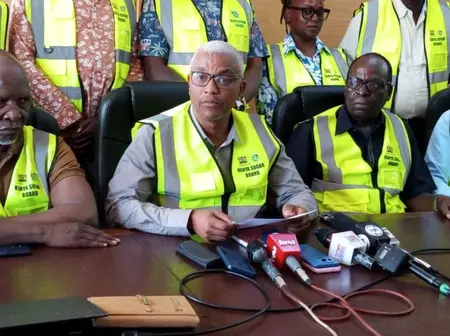
Kenya’s sugar industry has entered a new phase of governance after growers elected five representatives to the Kenya Sugar Board, handing farmers a direct voice in an industry long plagued by delayed payments, inefficient mills and disputes over cane supply.
The elections, held on Tuesday, November 24, 2026, mark a significant milestone in implementing the Sugar Act, 2024, which provides for democratically elected grower representatives in the board’s governance structure.
But the real test begins now. Winning an election is one thing.
Delivering reforms in an industry where farmers have repeatedly complained about poor returns, unreliable payments and the dominance of millers is another.
The election produced five winners representing the country’s sugar-growing catchment areas: Martin Dunda Kimeu for Coastal, Samuel Onyango Ong’ow for Central, Peter Otieno Midodo for Southern, James Mutei Wendaba for Upper Western and Janet Barasa Ataro for Lower Western.
Their election gives growers a formal platform to influence decisions affecting the industry, including mill performance, cane pricing, productivity and the sustainability of sugar production.
The significance of the new representatives lies in the constituency they carry.
It is a source of income, employment and economic survival for thousands of households across western Kenya, the Coast and other sugar-growing regions.
For farmers, the new board offers an opportunity to move from being largely subjects of industry decisions to participants in the institutions responsible for regulating and steering the sector.
The Ministry of Agriculture and Livestock Development and the Kenya Sugar Board conducted a registration and verification exercise that identified 108,372 eligible growers across five catchment areas.
Eighteen candidates were subsequently cleared to contest the elections.
“We reported voter turnout of about 43.9 per cent; however, this raises questions about the level of farmer participation in the exercise,” said Khator.
While the elections provide legitimacy to the new representatives, the turnout also suggests that the challenge of mobilising growers and strengthening confidence in sector institutions remains unfinished.
The Sugar Act was intended to introduce a new governance framework for an industry that has struggled with structural weaknesses.
The election of grower representatives is therefore more than a procedural requirement.
It is a test of whether legislation can translate into meaningful participation and accountability.
The newly elected directors will be expected to champion farmers’ interests at a time when the industry is under pressure to improve production, strengthen mill operations and reduce inefficiencies.
For farmers who invest heavily in land preparation, fertiliser, labour and harvesting, payment delays can disrupt household finances and undermine confidence in sugarcane farming.
The board is also expected to monitor the performance of sugar mills and push for reforms that improve cane crushing capacity, productivity and the sustainability of the industry.
Yet the interests of growers, millers, investors and government are not always aligned.
The new directors will have to navigate these competing interests while demonstrating that their election has produced tangible benefits for farmers.
The Southern Nyanza election is particularly significant because the region remains one of the country’s major sugar-producing areas, with farmers depending on the industry for livelihoods and local economic activity.
Midodo’s election places him at the centre of a sector facing growing expectations for better management, transparency and improved returns to growers.
The new representatives have been forwarded to the Cabinet Secretary for Agriculture and Livestock Development Mutahi Kagwe for gazettement as directors of the Kenya Sugar Board, where they are expected to serve three-year terms.
The new KSB board elect thanked the board for conducting free and fair elections and also thanked cane farmers for peaceful elections.
Midodo also thanked cane farmers for the democratic polls. “We are grateful to the farmers,” Midodo said.
KSB chief executive officer Jude Chesire also lauded the farmers for peaceful polls. He said they are now waiting to formally inaugurate them once they are gazetted.
But farmers will judge the board not by the ballot, the legislation or the promises made during the campaign.
They will judge it by whether their cane is harvested on time, their payments arrive when due, mills operate efficiently and sugar farming becomes a viable business again.
The industry has elected its representatives. Now the representatives must prove that the farmer’s vote can translate into economic power.
Khatof said they are expected to supervise the sugar industry reforms and pursue prompt payment of farmers and the industry reforms, among others.
Leave a Reply