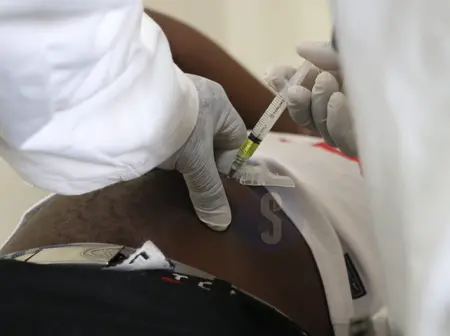
Men appear to have shied away from the injection that completely prevents HIV for six months.
New government figures indicate three out of every four people who have received Lenacapavir (Len) in Kenya are women.
The injection was introduced in February and prevents HIV even in condomless sex for six months.
National Aids and STI Control Programme (Nascop) head Dr Andrew Mulwa said demand for the drug is high, but the programme is facing stockouts due to limited supplies.
Kenya received about 21,000 initiation doses from the Global Fund, for the first phase covering 15 counties and 158 health facilities.
Health facilities issued 14,446 initiation doses between February and July. Uptake peaked in April and then declined as initiation stock ran short, with stock-outs reported at facilities from April onwards.
“The main challenge is inadequate supply of the originator product; about 12,000 further Global Fund-supported doses are still awaited,” Dr Mulwa said.
There is a push for generic manufacture globally, and the Global Fund has already cleared generic suppliers.
“Under an agreement with Unitaid, Wits RHI and Clinton Health Access Initiative (Chai), the generic will cost US$40 (Sh5,201) per person per year in the 120 low- and middle-income countries covered by Gilead's voluntary licence, including Kenya. First supplies are expected before the end of 2026, with wider availability in 2027,” Mulwa said.
He explained almost nine out of every 10 people who went for Len from February had never used PrEP before.
"This tells us LEN is bringing new people into HIV prevention, not simply moving existing oral PrEP users," Dr Mulwa said.
However, the gap between women and men raises questions about how health workers can make HIV prevention services more accessible and acceptable to men.
The low uptake among teenagers is another concern. Although girls aged 15 to 19 account for three in every 10 new HIV infections in Kenya, only 500 have gone for the injection.
Dr Mulwa said the country needed to reach more of the children aged 15 to 19, who remain under-represented in the programme.
He acknowledged that the current figures could underestimate demand because some young people who sought the injection could not get it when stocks ran out.
Len offers extremely high protection and two clinical trials in Uganda and South Africa show it is nearly 100 per cent effective at preventing HIV when taken as a twice-yearly injection.
The World Health Organisation recommended LEN as an additional HIV prevention option in 2025, describing it as a major advance because it offers protection without the need to take a pill every day.
Kenya's 2026 HIV estimates by the National Syndemic Diseases Control Council (NSDCC) show that about 1.48 million people are living with HIV in the country, with 13,936 new infections recorded in 2025. Women account for about 9,044 of the new infections, compared with 4,891 among men.
Last week, NSDCC boss Douglas Bosire said Kenya must reduce new infections because treating one person costs between Sh15,000 and Sh20,000 annually, translating to between Sh20 billion and Sh25 billion for the country's HIV population.
“Our desire is that by 2030, we will have zero new HIV infections. We are not saying that by 2030 we will not have people living with HIV. There will still be more than one million Kenyans living with HIV because we have succeeded in keeping people on treatment,” Bosire said.
He spoke ahead of the December 1 World Aids Day, which will be preceded by a national half marathon at Nyayo National Stadium in Nairobi on November 29.
The event will feature a 21km competitive race, a 10km road race, a 10km wheelchair race, a 5km family and corporate race and a 2km children's fun run.
On December 1, activities will take place across all 47 counties, including community dialogues, public accountability forums, candle-lighting ceremonies, memorial vigils and distribution of dignity packs.
Leave a Reply