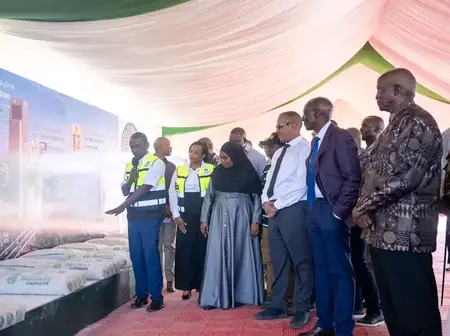
The groundbreaking ceremony took place on Tuesday, November 24, 2026, marking a new phase in Bamburi Cement's expansion and Kenya's efforts to increase local production of construction materials.
According to a report by The Star, the project represents a $250 million investment by Bamburi Cement, which is part of Amsons Group. The new facility is expected to produce 1.6 million tonnes of clinker annually.
Clinker is a key raw material used in cement manufacturing. Increasing its local production could help reduce Kenya's dependence on imports while strengthening the country's construction industry.
The financial commitment is substantial.
According to People Daily, the expansion will increase Bamburi Cement's annual clinker production capacity from one million tonnes to 2.6 million tonnes. Its cement production capacity is also expected to rise from 1.8 million tonnes to four million tonnes.
The development could have significant implications for Kenya's manufacturing sector, particularly as the country continues pursuing major infrastructure and affordable housing projects that require large quantities of cement.
Speaking during the groundbreaking ceremony, Amsons Group Managing Director Edha Nahdi described the investment as a demonstration of the group's confidence in Kenya's economic potential and its commitment to expanding local manufacturing, The Star reported.
The project is also expected to create business opportunities for residents and enterprises in Kwale County and the wider Coast region.
According to The Star, potential opportunities include transport, logistics, quarrying, equipment maintenance and other services required during construction and subsequent factory operations.
Bamburi Cement Chief Executive Geoffrey Ndugwa also said the new facility would address an important gap in Kenya's cement manufacturing value chain by increasing domestic clinker production.
The company plans to incorporate alternative fuels and raw materials, including coconut husks, cashew nut shells and municipal solid waste sourced from the Coast. The project will also feature a six-stage precalciner system designed to improve production efficiency.
Construction of the facility will be undertaken by China's Sinoma CBMI Construction Co. Ltd, according to The Star.
For residents of Matuga and neighbouring communities, the investment brings expectations of employment, business opportunities and increased economic activity.
However, as Kenya welcomes another major industrial investment, the bigger question remains: will projects of this scale eventually translate into more affordable cement and better economic opportunities for ordinary Kenyans?
Leave a Reply