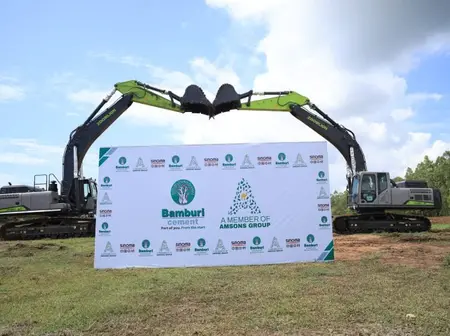
President William Ruto on Tuesday, November 24, 2026, witnessed the groundbreaking of Bamburi Cement’s Ksh32 billion clinker manufacturing plant in Matuga, Kwale County, in a major investment aimed at expanding local production of construction materials.
The project involves a $250 million (approximately Ksh32 billion) investment by Bamburi Cement, which signed an engineering, procurement and construction (EPC) agreement with China’s Sinoma CBMI Construction Co. Ltd in December 2025.
The new factory will have the capacity to manufacture 1.6 million tonnes of clinker annually, providing Bamburi with additional supplies of the key material used in cement production.
The investment is expected to more than double the company’s annual clinker production capacity from one million tonnes to 2.6 million tonnes. Its cement manufacturing capacity is also projected to increase from 1.8 million tonnes to four million tonnes.
Clinker is an essential intermediate material in cement manufacturing. It is produced by heating limestone and other raw materials at high temperatures before being ground with gypsum and other additives to produce cement.
Kenya’s dependence on imported clinker exposes local manufacturers to international prices, shipping expenses and foreign exchange fluctuations.
Increasing domestic production could help reduce these costs, improve the reliability of raw material supplies and strengthen the country’s cement manufacturing industry.
Speaking during the December 2025 contract signing, Bamburi Cement Chief Executive Officer Mohit Kapoor explained the importance of the investment.
“The new clinker line will greatly reduce reliance on imported clinker, improving quality production consistency and securing supply for the domestic market. This will save Forex resources, stabilise pricing, enhance production planning, and ensure Bamburi continues to meet rising cement demand driven by national infrastructure programmes and private sector development,” Kapoor said.
The additional capacity will also position Bamburi to supply more cement for construction projects, including housing, roads, railways, ports and other infrastructure developments.
However, increased production does not automatically mean lower retail cement prices, which are also influenced by energy, transport, distribution and other operating costs.
Amsons Group Managing Director Edha Nahdi said the investment was part of the conglomerate’s commitment to supporting Kenya’s infrastructure development and industrialisation.
“Amsons Group stands ready to make its contribution to support President Ruto’s 10-year roadmap on road, rail, ports, airports, and oil pipeline infrastructure development and expansion,” Nahdi said.
“By signing this Clinkerisation Plant development EPC contract, Amsons Group is putting its money where its mouth is, to power Kenya’s national development and economic transformation.”
Nahdi added that the availability of locally manufactured cement and concrete products would be important in delivering the government’s infrastructure ambitions.
The Ksh32 billion project is also expected to support President Ruto’s proposed Ksh5 trillion, 10-year national development roadmap, which includes major investments in transport infrastructure and other strategic sectors.
Beyond increasing production, the Matuga project is expected to create employment during construction and subsequent operations.
Local businesses are also expected to benefit from opportunities in transport, construction supplies, logistics, maintenance and other services required by the factory.
The plant will incorporate a six-stage precalciner system and technologies designed to improve energy efficiency and reduce emissions associated with cement manufacturing.
Bamburi has also identified alternative fuels and raw materials, including coconut husks, cashew nut shells and municipal solid waste, as part of its plans for cleaner production.
The use of these materials could create additional demand for agricultural waste and other locally available resources in the Coastal region.
President Ruto, who witnessed the EPC agreement signing in December 2025, said strengthening clinker production was important for the country’s industrial competitiveness.
“By combining Bamburi Cement’s deep local market presence and operational experience with SINOMA–CBMI’s global technical expertise in cement engineering and construction, this partnership will significantly strengthen domestic clinker production capacity, reduce reliance on imports, and enhance the competitiveness and resilience of Kenya’s cement industry,” Ruto said.
The project will be constructed by Sinoma CBMI, a Chinese engineering company specialising in cement plant development.
For Bamburi, the investment marks a major expansion under the Amsons Group, which acquired control of the cement manufacturer in 2024, while giving Kenya additional capacity to produce an important material for its construction industry.
Leave a Reply