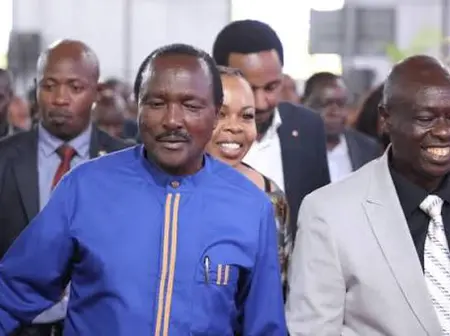
Although opposition leaders have repeatedly declared their commitment to challenging President William Ruto, their latest political engagements have raised questions about who will eventually control the coalition's direction and secure its presidential ticket.
The latest developments suggest that the opposition's biggest challenge may not be attracting supporters but managing the competing interests of its own leaders.
On Saturday, November 21, People Daily reported that Jubilee Party leader Fred Matiang'i, Narc Kenya leader Martha Karua, Kiharu MP Ndindi Nyoro and Siaya Governor James Orengo were preparing for a joint political tour of Kirinyaga County.
Their growing political association has attracted attention because of its potential influence on the opposition's leadership arrangements and the selection of its presidential candidate.
However, the emergence of this political grouping has also raised questions about whether a new centre of influence is developing within the broader opposition movement.
The debate became more prominent on Sunday, November 22, when opposition leaders held political engagements in Kirinyaga County.
According to Citizen Digital, Karua called for greater respect among opposition principals, insisting that every leader should be given an opportunity to participate in the search for the coalition's presidential candidate.
She also emphasised the importance of developing a common manifesto that would explain what the opposition intends to do if it wins the 2027 election.
Her remarks highlighted two major challenges facing the coalition: agreeing on a presidential candidate and establishing a common political programme.
Meanwhile, former Deputy President Rigathi Gachagua has continued strengthening his political influence through regional mobilisation.
During his engagements in Embu on November 22, Gachagua discussed the importance of bringing together different political regions to challenge the current administration.
His strategy highlights the importance of Mount Kenya, Kisii, Lower Eastern and the Coast in the emerging opposition calculations.
However, regional mobilisation alone does not guarantee that different political leaders will eventually agree on one presidential candidate.
The differences in political positioning became particularly interesting when Matiang'i and Nyoro dismissed suggestions that the opposition was breaking into competing factions.
According to reports published by Citizen Digital and The Star on November 22, the leaders maintained that the opposition remained united and would eventually present one presidential candidate.
Their reassurance came amid growing speculation about the emergence of competing political centres within the broader opposition.
The presidential succession question became even more complicated following another development involving former Attorney General Justin Muturi.
On November 22, Muturi declared that his Democratic Party had settled on Wiper leader Kalonzo Musyoka as its preferred presidential candidate within the opposition.
The announcement was made during a church service in Mwala, Machakos County, where Muturi accompanied Kalonzo.
The Star reported the endorsement again on November 23, highlighting its significance in the ongoing debate over the opposition's presidential ticket.
Although Muturi's endorsement does not automatically determine the coalition's final decision, it demonstrates how individual political parties are beginning to express their preferences.
This presents a potentially difficult situation because several influential opposition figures have their own supporters, political structures and ambitions.
Kalonzo brings years of political experience and an established support base in Lower Eastern.
Gachagua has concentrated on strengthening his influence in Mount Kenya, while Matiang'i is seeking to expand his national political profile.
Karua and Orengo also bring political experience and established networks that could influence the coalition's direction.
Nyoro, meanwhile, has continued attracting attention through his political engagements and economic arguments.
The challenge is finding a political arrangement that accommodates these different interests without creating a leadership contest that weakens the coalition before the election.
The opposition must also consider the expectations of ordinary Kenyans.
Unemployment, taxation, healthcare, education, corruption and the cost of living remain important issues that could influence voting decisions in 2027.
A coalition built around personalities and regional political arrangements may attract large crowds, but voters will eventually want to understand what its leaders intend to change.
This is where the opposition has an opportunity to distinguish itself from the current administration.
A common manifesto, credible leadership arrangements and clear economic proposals could help transform its political mobilisation into a serious national alternative.
However, failure to agree on these issues could create an advantage for the ruling administration.
President Ruto does not necessarily need the opposition to collapse for his re-election campaign to benefit. If competing political interests eventually produce multiple presidential candidates, opposition votes could be divided among different political camps.
That possibility makes the coming negotiations particularly important.
The developments between November 21 and 23 have exposed a central contradiction within the opposition. Its leaders are publicly insisting on unity while individual parties and political figures are already demonstrating their preferred approaches to leadership.
Ultimately, the coalition must decide whether its collective objective is more important than the individual ambitions of its principals.
But with Kalonzo receiving Muturi's endorsement, Gachagua consolidating his regional influence and Matiang'i emerging alongside Karua and Nyoro, who will be willing to sacrifice their presidential ambitions for the sake of opposition unity, and could their failure to agree ultimately hand William Ruto another term in 2027?
Leave a Reply