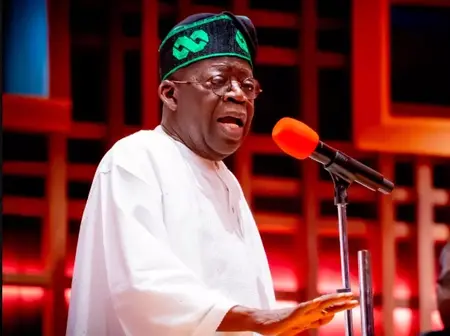
Nigerian President Bola Tinubu has shared his experience of a water outage at the Presidential Villa in Abuja, saying the interruption happened while he was shaving
The admission drew laughter from the audience as he recalled the incident and acknowledged the need to address the country's electricity and water supply challenges.
Tinubu was speaking at a special prayer event organised by his family in Lagos on Sunday, November 22, where he also spoke about his administration's plans for the country.
He said the interruption occurred during the previous week, giving his audience a glimpse of how the disruption affected even the country's seat of power.
"If I stay too long in Lagos, I will not want to rush back to Abuja. If I tell you some of you, on Wednesday last week, I was shaving and the water went off in the Villa," he said, prompting laughter.
The President went on to promise improvements in essential services, saying his administration was determined to address the challenges.
"We will correct all this: no light, no water, no electricity, no development. We are just starting. We can do it, and we will do it for Nigeria," he said.
His remarks brought attention to two longstanding infrastructure challenges in Africa's most populous country, where access to reliable electricity and water remains a major development concern.
Nigeria's electricity difficulties predate Tinubu's administration, with efforts to reform the sector stretching back more than two decades.
The government began pursuing major reforms in the early 2000s, leading to the Electric Power Sector Reform Act of 2005, which established the Nigerian Electricity Regulatory Commission and provided a framework for restructuring the industry.
In 2013, the government unbundled the state-owned Power Holding Company of Nigeria and transferred generation and distribution companies to private investors, while the transmission network remained under government ownership.
The reforms were intended to improve efficiency, attract investment and expand electricity supply, but challenges involving generation, transmission and distribution have continued.
Figures from the Nigerian Electricity Regulatory Commission show that grid-connected power plants had an average available capacity of 4,744 megawatts in October 2026, while average hourly generation stood at 4,047 megawatts.
The regulator said this represented utilisation of 85 per cent of the available generation capacity during the month.
Tinubu's 2023 presidential campaign manifesto, titled 'Renewed Hope: Action Plan for a Better Nigeria', identified electricity as a priority, promising to generate, transmit and distribute sufficient and affordable power.
The plan also proposed encouraging off-grid and renewable energy projects and working with state governments and private investors to expand electricity access.
Water supply was also included in Tinubu's campaign commitments.
His manifesto proposed a national potable water supply campaign, with a target of ensuring that by the end of the decade, no Nigerian would live more than five minutes away from a reliable source of drinking water.
The plan also proposed improving water infrastructure around major dams and expanding small-scale irrigation and water catchment systems.
Data from Nigeria's 2024 Demographic and Health Survey, published in September 2025, shows that 38 per cent of households had drinking water on their premises.
The survey further found that 71 per cent of the population had access to at least basic drinking water services, while 66 per cent had sufficient quantities of drinking water when needed.
Tinubu was sworn in as President on May 29, 2023. He has therefore been in office for more than three years as his administration continues to pursue its infrastructure and development agenda.
Leave a Reply