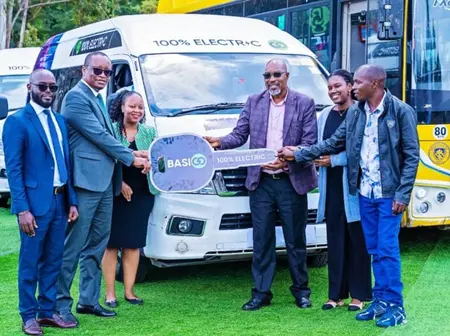
Kenya’s matatu industry is gradually embracing electric mobility, with 102 battery-powered buses deployed to serve public transport operators in a shift that could transform commuting while reducing pollution.
The expansion, highlighted by the Chinese Embassy in Kenya, demonstrates how Chinese technology and local vehicle assembly are contributing to the country’s transition towards cleaner public transport.
In a statement on Monday, November 23, 2026, the embassy highlighted the environmental and commuter benefits of the buses, noting that most had been assembled locally using kits sourced from China.
“By deploying 102 e-buses to serve public transport operators – most assembled locally from Chinese kits – a Kenyan company is carrying out a green transport shift that cuts emissions and noise and gives commuters a smooth, safe ride,” the embassy stated.
The deployment is being driven by BasiGo, a Kenyan electric mobility company that has partnered with local vehicle assemblers to introduce battery-powered buses into the public transport market.
Through its partnership with Kenya Vehicle Manufacturers, BasiGo assembles electric buses locally using imported components, with its assembly operations based in Thika, Kiambu County.
The arrangement allows Kenya to benefit from Chinese electric vehicle technology while developing domestic vehicle assembly capacity.
It also creates opportunities for local employment, technical skills development and the growth of the automotive industry.
BasiGo Managing Director Moses Nderitu told Xinhua that approximately 70 to 80 per cent of the buses were assembled locally using Completely Knocked Down (CKD) kits.
The company selected Chinese manufacturers because of their ability to supply and customise vehicles for the Kenyan market.
For matatu operators, electric buses offer an alternative to conventional diesel-powered vehicles, which expose businesses to fluctuating fuel prices and regular maintenance expenses.
Beyond the economic benefits, the transition is expected to improve the daily commuting experience.
Electric buses operate without engine noise or tailpipe emissions, offering passengers quieter journeys while reducing pollution along busy urban routes.
Johnson Kamau Wanja, a driver who operated diesel buses for 17 years before switching to electric vehicles, told Xinhua that the experience was significantly different.
“It is so much more comfortable driving an electric bus compared to a diesel one,” Wanja said.
The buses can cover approximately 190 to 230 kilometres during a typical working day before returning to charging depots, with a full charge taking about two hours.
Despite the progress, the transition faces challenges, particularly the high initial purchase cost of electric buses and the need for reliable charging infrastructure.
The vehicles require significant upfront investment, making financing arrangements important for operators seeking to replace conventional fleets.
Expanding charging stations, ensuring access to spare parts and training specialised technicians will also determine how quickly electric buses can become widespread.
Kenya’s renewable energy capacity, particularly geothermal, wind and solar power, provides an opportunity to support electric mobility while reducing dependence on fossil fuels.
The deployment of 102 buses therefore represents more than the introduction of new vehicles onto Kenyan roads. It demonstrates how Chinese technology, local assembly and private investment are creating an alternative for the country’s matatu industry.
The bigger test will be whether the model can expand beyond the initial fleet and become affordable and accessible to more public transport operators and commuters.
Leave a Reply