The United States is increasingly emerging as an important destination for Kenya’s opposition leaders as political formations position themselves ahead of the August 2027 General Election.
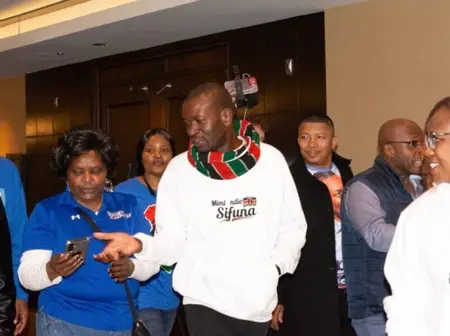
The latest visit by Linda Mwananchi leader and Nairobi Senator Edwin Sifuna has renewed attention on the trend, with opposition figures seeking engagements with American policymakers, political institutions and Kenyans living abroad.
The visits offer leaders an opportunity to popularise their political agendas, mobilise diaspora support, raise governance concerns and establish networks ahead of the electoral contest.
Sifuna’s US tour, running from November 21 to December 7, covers several states, including New Jersey, Pennsylvania, Maryland, Texas, Washington and California.
The Nairobi Senator is using the visit to popularise Linda Mwananchi, explain his political ambitions and engage Kenyans abroad on the country’s leadership and economic direction.
Speaking ahead of the trip, Sifuna said Kenyans in the diaspora had invited him to explain his political agenda and interrogate his vision.
“As a leader, I have a duty to explain to people what I intend to do with leadership. The country is for us all, so our brothers and sisters living in the US have invited us for a meeting,” he said.
His programme includes town hall meetings, engagements with business leaders, church gatherings and meetings with elected officials.
On Sunday, November 22, 2026, Sifuna opened Linda Mwananchi’s first international office in Hackettstown, New Jersey, where he criticised inadequate government support for Kenyans abroad.
He also raised concerns about consular services at the Kenyan Embassy in Washington and the recruitment of Kenyans to fight for Russia in the war against Ukraine.
The tour comes as Sifuna positions himself as a possible presidential contender and seeks to expand Linda Mwananchi’s political influence beyond Nairobi.
Former Deputy President Rigathi Gachagua also undertook an extensive American tour after leaving Kenya on August 26, 2026.
The Democracy for Citizens Party (DCP) leader visited Spokane in Washington State, Portland in Oregon, Kansas, Dallas in Texas and Boston in Massachusetts.
His engagements provided an opportunity to popularise DCP, consolidate diaspora support and discuss his political strategy ahead of 2027.
The tour was particularly significant as Gachagua sought to establish DCP as a major political vehicle in the Mt Kenya region while positioning himself as a central opposition figure.
Wiper Patriotic Front leader Kalonzo Musyoka has also used American engagements to raise concerns about Kenya’s democratic institutions.
On November 16, 2026, Kalonzo led a delegation comprising Martha Karua, Eugene Wamalwa, Justin Muturi and Robert Mbui to the Council on Foreign Relations (CFR).
The meeting, chaired by CFR President Michael Froman, focused on Kenya’s democratic institutions and preparations for the 2027 elections.
The opposition leaders raised concerns about the independence of the Independent Electoral and Boundaries Commission (IEBC), political violence, corruption and the weakening of constitutional institutions.
Kalonzo argued that the credibility of the electoral commission would determine the legitimacy of the next election.
“There can be no free and fair election when the Independent Electoral and Boundaries Commission is not independent,” he stated.
The delegation also questioned the use of public resources in political campaigns and raised concerns about attacks against opposition gatherings.
Former Chief Justice David Maraga has also extended his political mobilisation to the United States through his Ukatiba Caravan initiative.
Maraga, seeking the presidency on a United Green Movement ticket, undertook a three-week American tour in September 2026.
His itinerary included Washington, D.C., Maryland, Delaware, New Jersey, New York, Minnesota, Georgia, Houston and Dallas.
The engagements followed civic education activities across 43 Kenyan counties and sought to mobilise diaspora participation in the elections.
Maraga’s message has centred on constitutionalism, the rule of law and fighting corruption, themes forming the foundation of his presidential campaign.
The growing American interest reflects the political and economic importance of the Kenyan diaspora.
First, the US offers access to potential campaign financiers, professionals and entrepreneurs who could support political mobilisation.
Second, diaspora voters are becoming an increasingly important constituency. The IEBC has been pursuing expanded diaspora voting opportunities, making overseas Kenyans an audience political aspirants cannot ignore.
Third, engagements with American lawmakers and policy institutions provide opposition leaders with international platforms to raise concerns about governance, electoral preparedness and democratic accountability.
However, meetings with American institutions should not be interpreted as endorsements by the US government.
Ultimately, the visits reveal a growing contest for diaspora influence, international visibility and political networks.
Whether these engagements translate into grassroots support and electoral strength in Kenya will become clearer as the 2027 election approaches.
Leave a Reply