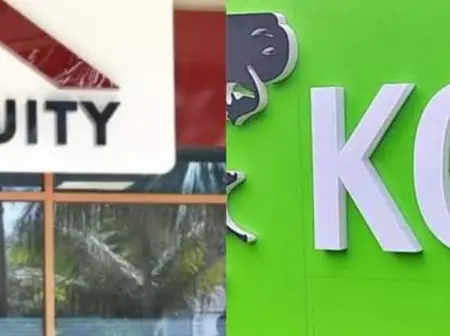
The idea was put forward by Kiharu MP Ndindi Nyoro on Thursday, November 19, 2026, as he discussed the financial performance of listed banks and the need for Kenyan lenders to strengthen their presence across Africa.
Nyoro suggested that the two institutions could combine to form a single banking group known as Equity KCB Group, arguing that such a move would give them greater financial strength and an opportunity to compete with major international lenders.
"Merging the two to create Equity KCB Group should not be far-fetched. It remains a viable idea," he said.
The proposed combination would bring together two of the country's biggest financial institutions, whose assets total approximately Ksh4.55 trillion.
Equity Group had assets worth Ksh2.15 trillion, while KCB Group's asset base stood at Ksh2.4 trillion.
Their financial results also show strong earnings. Equity reported Ksh71.5 billion in profit after tax for the nine months ending September 2026, against KCB's Ksh58.6 billion during the same period.
However, the possibility of having the two banks under one roof raises questions about what the arrangement would mean for millions of customers who rely on them for loans, savings and other financial services.
Currently, Equity and KCB compete for customers in personal banking, business loans, mortgages and digital financial services. A merger would reduce the number of major competitors in these areas, potentially affecting how the banks set lending rates and transaction charges.
While the combined institution could save money by bringing together its branches, technology systems and administrative operations, there is no guarantee that customers would enjoy cheaper services.
Regulatory approval would also be necessary before such a transaction could proceed. The Competition Authority of Kenya would examine its effect on market competition and public interest, while the Central Bank of Kenya would assess its implications for the banking sector.
The Capital Markets Authority could also have a role because both institutions are listed companies.
Questions surrounding ownership and management would need to be addressed. Equity has reported higher profits, but KCB controls a larger asset base. Their shareholders would therefore need a valuation to determine their respective stakes in any combined institution.
The future of employees would also be uncertain, particularly in departments where the two banks have similar operations. Consolidating branches and management structures could lead to staff restructuring.
Nyoro believes the merger could give the lenders more resources to pursue expansion opportunities in West and Southern Africa.
He pointed out that operations outside Kenya contributed 42 per cent of Equity's profits and 33.4 per cent of KCB's earnings.
However, he warned that Kenya's public debt remained a major risk to the banking sector, noting that a government default could undermine the benefits of the proposed expansion.
Despite the discussion, neither Equity nor KCB had announced a formal merger agreement by November 21, 2026. The proposal has not yet reached the stage of disclosed transaction terms, shareholder arrangements or an implementation timetable.
Whether Kenya needs one larger banking institution or continued competition between the two lenders remains a major question surrounding Nyoro's proposal.
https://www.facebook.com/100063646850476/posts/1758884759576402/?app=fbl
Leave a Reply