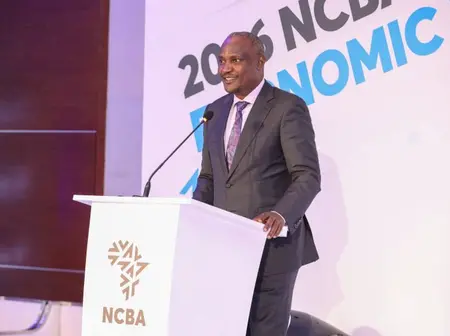
National Treasury Cabinet Secretary John Mbadi has urged commercial banks to lower interest rates and increase lending to businesses, farmers and micro, small and medium enterprises (MSMEs), saying borrowers should benefit more from recent monetary policy easing.
Speaking during the 2026 NCBA Economic Forum in Nairobi on Tuesday, November 3, Mbadi said the Central Bank of Kenya (CBK) had reduced its benchmark lending rate by more than four percentage points since mid-2024, but commercial banks had yet to fully reflect the cuts in their lending rates.
He noted that the Central Bank Rate (CBR) had fallen from 13 per cent in mid-2024 to 8.75 per cent, while the average commercial bank lending rate stood at 14.4 per cent.
“First, pass on the rate cuts. The Central Bank rate has come down by more than four percentage points since mid-2024. Yet the average lending rate is still at 14.4 per cent. Borrowers should feel more of that cut,” Mbadi said.
The Treasury CS also challenged banks to channel more funds towards productive economic activities, arguing that reduced government borrowing from commercial banks had created additional room for private-sector lending.
“Government is now borrowing less from the banks, and that frees room on your balance sheets. We expect that room to go to the businesses in this room and to farmers, manufacturers and MSMEs,” he added.
Mbadi said the strength of the banking sector should not only be measured through profits but also by the economic activities financed through lending.
“In the end, the truest of a strong banking sector is not in its profits alone, but the productive activity its strength makes possible,” he said.
The Cabinet Secretary said the government was working with the CBK to strengthen the banking sector and improve access to affordable credit.
He highlighted the risk-based credit pricing model, which he said was designed to ensure that changes in the policy rate were reflected more quickly in loan prices.
Mbadi also disclosed that frameworks for emergency liquidity assistance and a financial stability facility were at an advanced stage.
He said the proposed National Payments System Bill 2026 would modernise the legal framework governing digital payments.
On access to credit for smaller businesses, Mbadi said the government’s Credit Guarantee Scheme had helped unlock additional bank lending by sharing the risks associated with financing MSMEs.
He explained that every shilling committed by the government to the scheme had unlocked approximately Ksh2.50 in bank credit.
The government was also working to transform the scheme into the Kenya Credit Guarantee Company, which would be open to private capital.
Mbadi praised the banking sector for supporting Kenya’s economic resilience, citing an increase in assets and profitability.
He said banking sector assets grew by 13.1 per cent to Ksh8.9 trillion in the year to June 2026, while profits increased by 19.2 per cent to Ksh88.9 billion.
The CS also congratulated NCBA on its partnership with South Africa’s Nedbank, which he said was being finalised at the time of the forum.
He described the partnership as a vote of confidence in Kenya’s financial system.
The Treasury CS also used his address to defend the government’s economic management since 2022, saying fiscal discipline, tax reforms and structural changes had helped stabilise the economy.
He recalled that inflation stood at 9.2 per cent during the difficult economic period in 2022 and 2023, while the shilling weakened to Ksh160.8 against the US dollar in January 2024.
Foreign exchange reserves at the time covered only three to four months of imports, as Kenya faced a US$2 billion Eurobond repayment due in June 2024.
Mbadi said the government had opted for fiscal discipline and structural reforms under the Bottom-Up Economic Transformation Agenda (BETA) rather than allowing the country to slide into a debt crisis.
He reported that Kenya’s economy grew by an average of 5 per cent annually between 2022 and 2025, compared with the global average of 3.5 per cent and Sub-Saharan Africa’s 4.1 per cent.
He added that the economy expanded by 5.1 per cent in each of the first two quarters of 2026.
On inflation, Mbadi said the rate had fallen to 2.7 per cent in October 2024 before rising to 7.3 per cent in October 2026, which he said remained within the government’s target range of 2.5 to 7.5 per cent.
He also reported that the shilling had strengthened to an average of Ksh129.9 against the dollar in October, while foreign exchange reserves had increased to US$14.9 billion, equivalent to 6.1 months of import cover.
The CS further said Kenya had reduced its exposure to Eurobond repayment risks through refinancing and buybacks, extending the external debt maturity profile to 2039.
He added that credit rating agencies Moody’s and Standard & Poor’s had upgraded Kenya’s credit rating, while Eurobond yields had fallen by more than 200 basis points.
Mbadi said foreign direct investment had doubled from US$1.6 billion in 2022 to a record US$3.2 billion in 2025.
He attributed the growth partly to the gazettement of 17 special economic zones and 23 export processing zones.
He also said the Nairobi Securities Exchange’s market capitalisation had crossed KSh4 trillion for the first time in nearly a decade, while the market was the fourth-best performing stock market globally in the first half of 2026.
In agriculture, Mbadi said the cost of a 50-kilogramme bag of subsidised fertiliser had dropped from approximately Ksh7,000 to Ksh2,000.
He estimated that the intervention had saved farmers Ksh105 billion and contributed to an increase in maize production from 34 million bags to 46 million bags.
He added that maize imports had fallen to a third of their previous levels.
The CS also cited the Hustler Fund, which he said had disbursed Ksh90.4 billion to 28.1 million Kenyans, while the Social Health Authority had registered 31.6 million people.
He further highlighted progress in the affordable housing programme, land ownership and electricity access, saying more than 1.14 million title deeds had been issued and over 10.4 million new homes and businesses connected to electricity.
Looking ahead, Mbadi said the government would focus on protecting the economic gains as Kenya approaches the 2027 General Election.
He said the progress had come at a cost, acknowledging that Kenyans had paid more taxes during difficult economic years and that many households continued to experience financial pressure.
“This progress was not free. Kenyans paid more in taxes during difficult years, and many households still feel that life is hard. Having paid the price for stability, it would be unforgivable to lose it,” he said.
Mbadi said the government would also explain the public finance management reforms behind the economic recovery and outline preparations for Kenya’s development beyond Vision 2030.
He described the reforms as deliberate interventions, many involving changes to public finance management, which he said had helped create the conditions for economic stability.
Leave a Reply