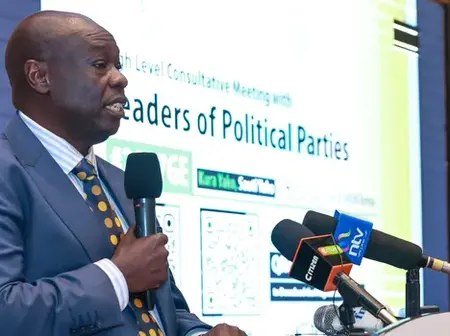
Gachagua warned that failure by the commission to respond to the questions could force opposition leaders to mobilise Kenyans across the country to demand answers directly from the electoral body.
Speaking on Sunday, November 22, during a church service at Wonders of God Church in Runyenjes Constituency, Embu County, the Democracy for the Citizens Party (DCP) leader accused IEBC of failing to provide satisfactory explanations on issues surrounding election preparedness.
He said opposition leaders wanted to engage IEBC Chairperson Erastus Edung Ethekon and other commissioners directly, insisting that their concerns should not be dismissed as political attacks.
One of the key issues Gachagua wants addressed is the state of the national voters' register. He called for an independent audit to establish whether the register contains names of deceased persons, duplicate entries or individuals who may have been registered unlawfully.
The former Deputy President also questioned claims that foreign nationals from neighbouring countries, including Uganda and Somalia, had been included in the register.
He demanded investigations into the allegations and urged the commission to establish a clear timeline for conducting the audit. However, he did not provide evidence to support the claims about foreign nationals being registered as voters.
Gachagua also raised concerns about the election technology expected to support the 2027 polls, particularly the contract involving Smartmatic, which he claimed was due to expire on November 24, 2026.
He questioned how the commission would manage future voter registration activities if the existing arrangement ended before a replacement system was secured.
His concerns come as IEBC faces legal and procurement challenges surrounding the acquisition of election technology and ballot papers.
On Sunday, the commission's Director of Voter Registration and Electoral Operations, Salome Nderitu, reportedly indicated that ongoing court proceedings had affected some procurement activities. She said the commission had advertised relevant tenders but was awaiting court decisions before taking further steps.
Beyond technology and the voters' register, Gachagua accused Interior Principal Secretary Raymond Omollo of allegedly influencing voter registration activities in certain parts of the country.
He claimed that some regions were receiving preferential treatment in voter registration and the processing of national identity cards, while young people in other areas experienced lengthy delays.
The DCP leader did not provide documentary evidence to substantiate the accusations against the Interior PS.
He further challenged IEBC's proposed approach to presidential election results, rejecting the use of Bomas of Kenya as the national tallying centre.
Gachagua argued that presidential election results should be announced at constituency level, with political parties independently adding up the figures from across the country.
He maintained that the opposition would not support an arrangement it believes could create opportunities for electoral manipulation.
However, the constitutional framework requires IEBC to tally and verify presidential election results before declaring the winner, while the Elections Act provides for the transmission of results to the national tallying centre.
The warning comes against the backdrop of growing disagreements between opposition leaders and the electoral commission.
On Thursday, November 19, a group of opposition politicians, including Wiper Party leader Kalonzo Musyoka and former Chief Justice David Maraga, walked out of a consultative meeting with IEBC after raising concerns about the preparations for the next General Election.
The commission subsequently defended its handling of the meeting, saying the leaders had presented their initial concerns before leaving, without allowing the scheduled discussions to proceed.
IEBC also maintained that it remained open to receiving formal proposals from political parties on electoral reforms and pledged to conduct credible, transparent and peaceful elections on August 10, 2027.
Despite the commission's position, Gachagua insisted that opposition leaders would not abandon their demands.
He specifically directed his message to IEBC chairperson Ethekon, saying the commission had until January to engage political leaders and respond to the outstanding questions.
He warned that if the deadline passed without meaningful engagement, the opposition would turn to the public to press for answers.
Invoking the 2024 Gen Z demonstrations against the Finance Bill, Gachagua suggested that the public reaction to concerns over the next election could be significant if Kenyans lost confidence in the electoral process.
He maintained that his demands were aimed at ensuring all eligible citizens had an equal opportunity to register and participate in the 2027 General Election.
The latest remarks add pressure on IEBC as political leaders intensify scrutiny of election preparations, with the dispute over electoral reforms emerging as an increasingly important issue ahead of the August 2027 polls.
https://www.facebook.com/share/1CexpUfuho/
Leave a Reply