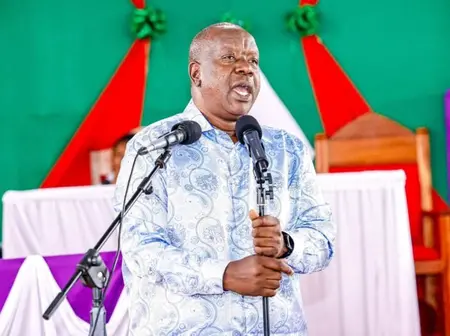
Jubilee Party Leader Fred Matiang’i has signalled that he will not support political alliances built around leaders with whom he has fundamental disagreements, raising questions about his approach to opposition politics ahead of the 2027 General Election.
Matiang’i said he was only willing to engage with leaders who shared his political outlook and were prepared to work towards addressing Kenya’s challenges, suggesting that political compatibility would be an important consideration in any future working arrangement.
“I cannot sit with someone we do not see eye to eye. I can only sit with people we can work with,” Matiang’i said while speaking at a church event at ACK St. Mary’s Church, Kimunye, in Gichugu Constituency, Kirinyaga County on Sunday, November 22, 2026.
His remarks come as opposition leaders face growing pressure to consolidate their political support ahead of the 2027 elections, with the question of who should lead a possible challenge against President William Ruto remaining central to opposition calculations.
The opposition has repeatedly faced the challenge of balancing individual presidential ambitions, regional political interests and competing approaches to confronting the government. Building a common political platform requires leaders to negotiate not only their policy differences but also questions of leadership and influence.
Matiang’i’s latest position introduces another consideration into those calculations: the extent to which he is willing to accommodate political differences in pursuit of a broader electoral arrangement.
Although he did not identify the leaders he was unwilling to work with, his statement raises questions about whether he sees himself as part of an existing opposition arrangement or intends to establish an independent political platform before considering possible partnerships.
The former Interior Cabinet Secretary has emerged as a potential presidential contender ahead of the next General Election, although his ability to translate that political ambition into a nationwide electoral following remains to be established.
During his address, Matiang’i singled out Kiharu MP Ndindi Nyoro, describing him as a straightforward leader who understands the solutions needed to address Kenya’s challenges.
“I know Ndindi. He is a straightforward man and knows the solutions that are needed,” he said.
The mention of Nyoro is notable because it provides an indication of the kind of leadership Matiang’i says he values.
However, he did not announce a political agreement with the Kiharu legislator or indicate whether the two had discussed working together ahead of the 2027 elections.
Matiang’i also sought to distinguish his political approach from what he described as unnecessary political exchanges, saying his camp was concentrating on developing solutions for Kenyans.
“We will provide solutions. We are not here for stories; we are here for solutions,” he said.
For opposition leaders, the period leading to the 2027 General Election presents an important opportunity to establish a credible alternative to the Kenya Kwanza administration.
However, bringing different political formations together requires more than shared criticism of the government. Leaders must agree on the direction of a possible coalition, its leadership structure and how competing presidential ambitions will be addressed.
Matiang’i’s remarks highlight the tension between maintaining political independence and participating in the compromises often required to build a broad electoral alliance.
His emphasis on shared political views could help define the political identity of his camp. However, it also raises questions about how widely he is prepared to extend his political engagement if differences emerge over strategy, leadership or policy priorities.
For Jubilee, the challenge will be demonstrating that it can provide the organisational and political foundation for Matiang’i’s ambitions while attracting support beyond its existing networks.
Ultimately, Matiang’i faces a significant political calculation ahead of 2027: whether to build his own political base and negotiate with other leaders from that position, or accommodate competing interests early enough to become part of a broader opposition arrangement.
His latest remarks have made clear that he does not intend to pursue political partnerships without conditions. Whether that approach strengthens his bargaining position or complicates efforts to build wider political support remains an open question.
Leave a Reply