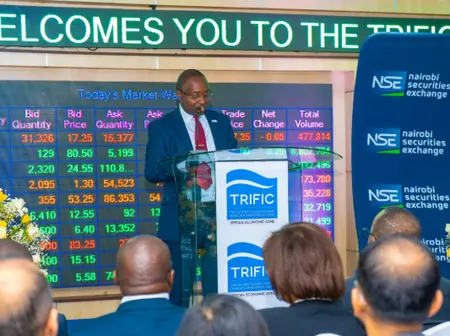
Kenya’s stock market lost approximately Ksh96 billion in value in September 2026, reversing part of a strong rally that had pushed the Nairobi Securities Exchange (NSE) above the Ksh4 trillion mark.
Data from the Kenya National Bureau of Statistics (KNBS) shows that market capitalisation declined from Ksh4.218 trillion in August to Ksh4.122 trillion in September, a drop of about 2.3 per cent.
The decline raises questions about investor confidence and the value of shares held by individuals, pension funds and other institutional investors.
However, the fall does not mean Ksh96 billion in cash was withdrawn from companies or disappeared from the economy. Market capitalisation measures the combined value of listed shares at prevailing market prices.
The September decline followed a strong rally that had lifted the NSE’s valuation throughout much of 2026.
KNBS figures show that market capitalisation increased from Ksh2.784 trillion in September 2025 to Ksh4.122 trillion in September 2026, representing annual growth of approximately 48 per cent.
The Nairobi All Share Index (NASI) declined from 251 points in August to 246 points in September, while the NSE 20 Share Index eased from 4,326 to 4,317 points.
Market reports at the time linked the correction to profit-taking after the rally and foreign investor selling. These explanations provide context but are not causes established by KNBS.
The decline in market value can affect investors whose portfolios contain shares that lost value during the month. Investors may see the quoted value of their holdings fall even when they have not sold their shares.
But the KNBS data also reveals an interesting contrast: the volume of shares traded fell from 767 million in August to 640 million in September, while equity turnover increased from Ksh27.7 billion to Ksh28.9 billion.
The number of equity transactions also rose from 291,006 to 347,203. This shows that trading remained active despite the decline in market value.
For businesses, weaker share prices can make equity fundraising less attractive because companies may have to offer more shares to raise the same amount of money. However, the September figures do not show that any listed company cancelled or delayed a fundraising plan.
Despite the monthly decline, the NSE remained significantly more valuable than it was a year earlier. The 48 per cent annual increase in market capitalisation provides important context and shows why September should not automatically be interpreted as the beginning of a prolonged market downturn.
Investors will be watching company earnings, dividend performance, share valuations and broader economic conditions to assess whether the correction continues.
For ordinary Kenyans, the key lesson is that a rising stock market can increase the quoted value of investments, but those gains can also reverse. The September figures show a market that has surrendered some recent gains, but remains substantially larger than it was in September 2025.
Leave a Reply