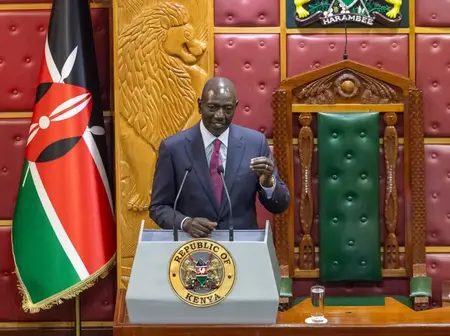
Kenya's journey from economic distress to renewed growth and the challenge of translating that recovery into prosperity for ordinary citizens took centre stage on Wednesday as President William Ruto delivered his fourth State of the Nation Address to a joint sitting of Parliament in Nairobi.
In an address lasting more than two hours, the President presented an account of his administration's performance over four years.
He outlined achievements in economic stabilisation, agriculture, healthcare, education, housing and employment while setting out an ambitious development agenda for the country's future.
With the August 2027 General Election less than nine months away, the address carried particular significance.
It offered the Head of State an opportunity to account for his administration's record, respond to persistent public concerns and explain how the country intends to sustain its economic recovery.
His central proposition was that Kenya has moved from rescuing an economy under pressure to rebuilding its productive foundations, with the ultimate objective of ensuring that prosperity reaches every household and every county under his motto, “Usawa ni Sawa.”
"Our nation is making a powerful comeback," President Ruto declared, arguing that the progress was the result of deliberate reforms and the resilience of Kenyans.
Restoring confidence in the economy
The President began by addressing the cost of living, which is one of the most pressing concerns facing households and businesses.
He recalled the economic pressures confronting the country in 2022, including a weakening currency, elevated inflation, expensive credit and concerns about the country's ability to meet its international financial obligations.
According to the President, the Kenyan shilling has stabilised at approximately KSh129 against the US dollar, having recovered from nearly KSh162.
Inflation, which reached 9.6 per cent in 2022, averaged 4.1 per cent in 2025, while foreign exchange reserves increased from US$7.37 billion to US$15.3 billion.
He also cited the repayment of the US$2 billion Eurobond in June 2024 as evidence of restored financial credibility.
Commercial bank lending rates have declined from 17.2 per cent in November 2024 to approximately 14.4 per cent in September 2026, he pointed out.
The significance of these developments, he argued, extends beyond economic statistics.
A stable currency, lower inflation and more affordable credit create an environment in which businesses can invest, farmers can produce and households can better manage their finances.
Agriculture and the household economy
President Ruto identified agriculture as one of the most direct channels through which economic reforms are reaching ordinary Kenyans.
The reduction of fertiliser prices from KSh7,500 to KSh2,000 per 50-kilogramme bag, he said, had helped lower production costs and increase agricultural output.
He cited the experience of Laban Cheptarus, a maize farmer in Rongai, Nakuru County, whose production increased from 75 bags to 125 bags on the same five-acre land following access to affordable fertiliser, provision of quality seeds and enhanced agricultural extension services.
National maize production, according to the President, increased from 44.3 million bags in 2022 to 71 million bags last year, while the average price of two kilogrammes of sifted maize flour declined from KSh230 in September 2022 to KSh152 in September 2026.
He also highlighted improved earnings in the coffee, tea and dairy sectors, alongside a KSh1.2 billion bonus package for sugarcane farmers.
These interventions, he maintained, are intended to achieve two complementary objectives: increasing farmers' incomes and making food more affordable to consumers.
Healthcare, education and housing
Beyond agriculture, the President devoted considerable attention to the social sectors, arguing that economic progress must also be measured by the ability of citizens to access essential services without suffering financial hardship.
He reported that 33.7 million Kenyans had registered with the Social Health Authority, compared with approximately eight million under the former NHIF in 2022.
He cited patients receiving cancer treatment, dialysis and kidney transplants through SHA as examples of the importance of collective health financing, particularly for families facing expensive medical procedures.
In education, he reported that the government had employed 100,000 teachers, constructed 23,000 classrooms and increased the annual education allocation from KSh521 billion in 2022/23 to KSh784 billion in the current financial year.
The affordable housing programme was another major feature of the address. More than 313,000 homes are at various stages of construction across the 47 counties, while the programme has generated over 1.1 million employment opportunities, according to the President.
He argued that housing investment should be understood not merely as a shelter initiative but also as an economic intervention creating opportunities for artisans, construction workers, manufacturers and small businesses.
Opening opportunities for young people
Recognising the challenge of youth unemployment, President Ruto highlighted the digital economy, international labour mobility and enterprise financing as important avenues for expanding employment.
He reported that 350,000 Kenyans had secured work in the digital economy, while 707,000 had obtained employment opportunities abroad.
The NYOTA programme, which provides young entrepreneurs with training, mentorship and start-up capital, was also highlighted.
More than 133,000 young people have reportedly received KSh50,000 each to establish or expand businesses.
The President maintained that the next challenge is to help these enterprises grow, access markets and create additional employment.
He also announced proposals to exempt workers earning KSh32,333 or less monthly from PAYE, remove stamp duty on land transactions valued at KSh1 million or less and eliminate the 25 per cent import duty on mobile phones.
These proposals, alongside the settlement of verified pending bills and outstanding government obligations to universities and hospitals, are intended to ease financial pressure on households and businesses, the Head of State observed.
A bigger development ambition
Looking ahead, the President outlined an ambitious infrastructure programme intended to move Kenya beyond economic stabilisation towards higher levels of productivity and industrialisation.
He proposed a National Infrastructure Fund, with KSh340 billion earmarked for an ambitious KSh5 trillion, 10-year investment programme.
Its targets include 28,000 kilometres of tarmac roads, 10,000 megawatts of electricity generation capacity, 50 mega dams and irrigation of 2.5 million acres of cropland.
The President presented these investments as essential to reducing the cost of doing business, strengthening food security, expanding manufacturing and positioning Kenya for higher levels of economic development.
He also emphasised equitable development, arguing that access to opportunity should not depend on where a Kenyan is born or the historical development status of their community.
The accountability question
While the address presented an optimistic account of Kenya's development trajectory, the President also acknowledged that the national transformation agenda remains unfinished.
His commitments on compensation for victims of protests and injured police officers, police reforms and accountability for wrongdoing spoke to the importance of public trust and constitutional freedoms.
He further called for a political culture in which leaders are judged by their ideas, development proposals and record of delivery rather than ethnic identity.
Ultimately, the significance of the 2026 State of the Nation Address will be determined by what happens beyond Parliament.
The economic indicators must translate into lower household expenses, employment opportunities, reliable public services and improved incomes.
Infrastructure targets must become completed projects, while announced reforms must deliver tangible results.
For a country preparing for another electoral contest, the President has placed his administration's record and future ambitions before the public.
The challenge now is to turn the promise of recovery into a development story experienced by every Kenyan.
As President Ruto concluded, “the task of building a prosperous, equitable and united Kenya must continue.”
The foundation, he affirmed, has been laid. The test now is delivery.
Lawrence Kinoti works at the Office of the Government Spokesperson.
Leave a Reply