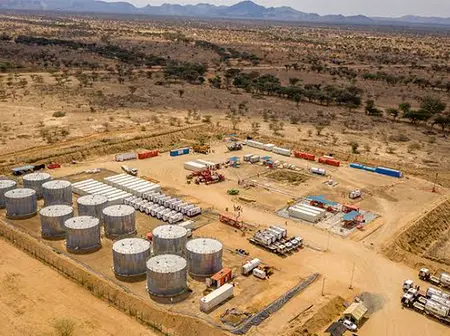
Kenya's journey towards exporting crude oil from Turkana involves more than drilling wells. Production facilities, transportation arrangements and storage infrastructure must all be ready before the oil can reach international markets.
Production drilling began at the Amosing 1 well pad in the South Lokichar Basin on November 20, 2026. The project is being developed by Gulf Energy E&P BV SEZ under the government's approved development plan.
However, the beginning of drilling does not mean that exports can start immediately. Several stages must be completed before the first shipment leaves the country.
The first phase of the South Lokichar oil project is designed to produce approximately 20,000 barrels of crude oil per day.
According to the South Lokichar Field Development Plan presented to Parliament, this phase will focus on the Ngamia and Amosing fields. It includes plans for 48 production and injection wells, together with the facilities required to support oil production.
The wider development covers six oil discoveries: Ngamia, Amosing, Twiga, Ekales, Agete and Etom.
These discoveries will not all enter production at the same time. The project will be developed in phases, with the second phase expected to increase production capacity to approximately 50,000 barrels per day.
The initial target therefore represents only the first stage of a larger oil development programme.
Transporting crude oil from Turkana to the coast is one of the major requirements for starting exports.
During the initial phase, the oil is expected to be transported by road tankers. The trucks will carry crude from the South Lokichar oil fields to the Kenya Petroleum Refineries Limited storage facilities in Changamwe, Mombasa.
The Energy and Petroleum Regulatory Authority's 2026 statistics report outlines a transport arrangement involving approximately 600 trucks. The system is expected to support about 100 truck journeys per day, with an average round trip taking six days.
After reaching Mombasa, the crude will be stored before being prepared for export through the Kipevu Oil Terminal 2.
This makes reliable road transport and adequate storage capacity important parts of the export plan. Delays or disruptions along the transport route could affect the movement of crude oil from the production fields to the coast.
The project has two important target dates that should not be confused.
Gulf Energy is targeting December 1, 2026, for the start of first oil production. However, the first export shipment is expected to leave Kenya on March 1, 2027, according to the Kenya News Agency.
The difference between these dates reflects the work required after production begins.
Once crude oil is produced, it must be collected, transported to Mombasa and stored before arrangements can be completed for export. The process involves several activities, meaning that the start of production does not automatically translate into an immediate shipment.
The March 2027 date is therefore a target that depends on the successful completion of these arrangements.
The South Lokichar project is also expected to create opportunities for businesses and workers, particularly in Turkana County.
According to information reported by the Kenya News Agency following a media engagement in Turkana, Gulf Energy Country Manager Frankline Juma said 400 of the 600 trucks planned for crude transportation had been reserved for transporters from local communities.
The company also reported that 599 of the 716 jobs in the project were held by Kenyans. Of those Kenyan employees, 61 per cent were from Turkana County.
These figures were provided by the company and reported by the Kenya News Agency. They should therefore be understood as company-reported figures rather than independently audited employment statistics.
As the project expands, the extent to which local communities benefit will depend on the availability of jobs, business contracts and opportunities for local transport operators.
The planned production of 20,000 barrels per day is not the project's final target.
Under the development plan, the second phase is expected to increase production capacity to approximately 50,000 barrels per day. Reaching this level will require further drilling and additional investment in production infrastructure.
Transport arrangements will also need to accommodate any increase in the volume of crude being produced.
The Energy and Petroleum Regulatory Authority's report discusses the transport requirements associated with the project's development. While road tankers are planned for the initial phase, future arrangements may require additional infrastructure and regulatory approvals.
This means that expanding production will involve more than increasing the number of operating wells. The systems used to move and handle the oil must also be able to support higher volumes.
The beginning of production drilling is an important development for Kenya's petroleum sector, but it does not by itself guarantee the project's long-term success.
The actual economic benefits will depend on how much oil can be produced, the costs involved and the revenue earned from selling it.
International crude oil prices, transportation expenses and the cost of developing the oil fields will all influence the project's financial performance.
For now, attention is on whether Gulf Energy can meet its December 2026 first-oil target and complete the preparations needed for the planned March 2027 export shipment.
Kenya has moved closer to commercial oil production, but the next major test will be turning the drilling activity in Turkana into a reliable production and export operation.
Leave a Reply