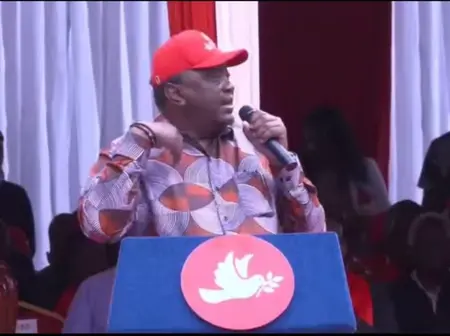
Retired Kenyan President Uhuru Kenyatta has mourned former South African Deputy President Phumzile Mlambo-Ngcuka, praising her contribution to public service, gender equality and women’s empowerment following her death.
In a condolence message on Saturday, November 21, 2026, Kenyatta extended his sympathies to the Government and people of South Africa, as well as the family of the late former Deputy President.
The former Kenyan Head of State remembered Mlambo-Ngcuka as a distinguished leader whose work in advancing women’s rights had left a lasting mark on South Africa and beyond.
He described her contribution to gender equality and women’s empowerment as an enduring legacy, recognising her service to the country and her efforts to improve opportunities for women.
Kenyatta also prayed for strength, comfort and courage for the bereaved family and the people of South Africa as they come to terms with what he described as a profound loss.
His message comes as South Africa and the international community mourn the death of a political leader who broke barriers in public leadership and later became a prominent voice for women’s rights at the United Nations.
South Africa’s Presidency announced on Friday, November 20, 2026, that Mlambo-Ngcuka had died, prompting tributes from political leaders and institutions across the country and beyond.
Acting President Paul Mashatile received the news with shock and sadness and conveyed condolences to the family on behalf of President Cyril Ramaphosa, the government and the people of South Africa.
The Presidency said further details would be communicated after consultations with the family, which requested privacy during the period of mourning.
Mlambo-Ngcuka was 71. Her death was also confirmed by international news organisations, including Reuters and Associated Press.
First woman to serve as South Africa’s Deputy President
Mlambo-Ngcuka made history in June 2005 when she became the first woman to serve as Deputy President of South Africa.
She held the position under former President Thabo Mbeki until September 2008.
Before her appointment, she served as Minister of Minerals and Energy from 1999 to 2005 and Deputy Minister of Trade and Industry between 1996 and 1999.
She was also among the first generation of lawmakers to serve in South Africa’s democratic Parliament following the end of apartheid in 1994.
Her political career included participation in the country’s Constitutional Assembly, which contributed to the development of South Africa’s democratic Constitution.
Beyond her political career in South Africa, Mlambo-Ngcuka became an influential figure in international development and gender equality.
In August 2013, she was appointed Executive Director of UN Women, the United Nations entity responsible for advancing gender equality and empowering women and girls.
She also served as a United Nations Under-Secretary-General, leading global advocacy for women’s rights, economic opportunities and greater representation of women in leadership.
Her tenure at UN Women lasted until 2021.
During this period, she worked with governments, international organisations and civil society groups to promote policies aimed at improving the lives of women and girls.
Her leadership placed particular emphasis on translating commitments to gender equality into practical action and investment.
The United Nations and African Union have also paid tribute to her contribution to women’s empowerment and public service following news of her death.
Kenyatta’s condolence message recognises a legacy that extended beyond South Africa’s political institutions to the international campaign for gender equality.
For a leader who became South Africa’s first female Deputy President before taking on one of the United Nations’ most prominent gender equality roles, her contribution to women’s representation and empowerment remains a central part of her public record.
Leave a Reply