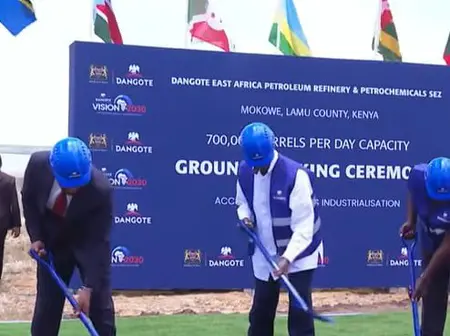
Nigerian billionaire Aliko Dangote is building an expanding industrial footprint across East Africa, with investments spanning oil refining, fertiliser production, cement manufacturing and cross-border energy infrastructure.
A comparison of the projects announced across the region reveals an interesting pattern: Ethiopia has attracted a wider range of Dangote’s industrial investments than Kenya, even as Kenya hosts the proposed flagship oil refinery in Lamu.
The distinction is important. Kenya’s refinery is an enormous single investment, but Ethiopia’s portfolio combines fertiliser production, cement expansion, new manufacturing facilities and fuel transportation infrastructure.
Kenya is hosting what could become the largest single investment in Dangote’s East African portfolio: the proposed Lamu oil refinery valued at approximately Ksh2 trillion.
The project was officially launched at Mokowe, Lamu County, on September 30, 2026, in a ceremony attended by President William Ruto, Dangote and other African leaders.
The refinery is designed to process up to 700,000 barrels of crude oil per day, making it one of the largest proposed facilities of its kind globally.
The wider industrial complex is expected to include:
The Kenyan government says the investment could create up to 60,000 direct and indirect jobs. Dangote also pledged to commission the refinery within 40 months.
Kenya’s project is therefore not simply a refinery. It is intended to become an industrial and energy hub serving neighbouring countries.
Ethiopia has attracted a broader collection of Dangote projects, particularly in fertiliser manufacturing and cement production.
Dangote Group partnered with Ethiopian Investment Holdings to develop a major urea fertiliser complex in Gode, in Ethiopia’s Somali region.
The project is valued at approximately US$2.5 billion, equivalent to roughly Ksh325 billion at an illustrative exchange rate of Ksh130 per dollar.
It is designed to produce up to three million tonnes of urea annually.
Dangote Group holds a 60 per cent stake, while Ethiopian Investment Holdings owns the remaining 40 per cent.
Construction began in October 2025. The project is expected to reduce Ethiopia’s dependence on imported fertiliser and potentially supply neighbouring countries, including Kenya and Somalia.
Dangote Cement has announced a US$380 million investment in expanding its existing Mugher cement plant.
The expansion involves a second production line and a new cement grinding unit.
According to the company’s September 2026 capital markets presentation, the expansion and associated grinding capacity are expected to add approximately 2.5 million tonnes annually, taking the facility’s production capacity to five million tonnes.
The investment builds on Dangote’s existing cement operations in Ethiopia, which began in 2015.
Another major project involves a petroleum products pipeline connecting Damerjog in Djibouti to Dewele in Ethiopia.
The announcement was made by Ethiopian Prime Minister Abiy Ahmed in September 2026 following discussions involving Dangote Group and Ethiopian Investment Holdings.
The project is intended to reduce transportation costs and delays along the Ethiopia-Djibouti corridor.
Storage terminals are planned at both ends of the pipeline.
Ethiopia’s wider investment discussions also include NPK fertiliser manufacturing, additional cement capacity and possible acquisitions.
However, the specific proposed NPK facility with a two-million-tonne annual capacity, as well as the reported new cement plant and acquisition, could not be independently confirmed from the latest company disclosures reviewed.
They should not yet be presented as completed investments or projects with confirmed construction schedules.
Dangote’s most established industrial investment in Tanzania is the cement plant in Mtwara.
The facility was commissioned in December 2015 and has an annual production capacity of approximately three million tonnes.
It is an existing operation, rather than a newly announced project.
However, Dangote has held discussions with the Tanzanian government on additional investments, including port development, a special trade zone, transport infrastructure, fertiliser manufacturing and a proposed 2,000MW power plant.
The discussions also include a proposed 40-kilometre concrete road to support port operations and a transport link between Mtwara and Mbamba Bay.
These proposals could significantly expand the group’s presence in Tanzania, although they remain at different stages of discussion and development.
Uganda is another country Dangote has identified for possible investments, although the discussions are not yet equivalent to the confirmed projects in Kenya and Ethiopia.
The areas of interest reportedly include:
Uganda’s oil discoveries and planned petroleum infrastructure make it a potentially important market for industrial investment.
The country’s crude oil could also become an important source of feedstock for the proposed Lamu refinery, depending on regional supply arrangements and commercial agreements.
For now, these should be understood as potential investment areas rather than confirmed construction projects.
The contrast is particularly interesting because Kenya has secured the most expensive single project in the announced portfolio.
Ethiopia, however, is attracting investments across several different industries.
There are three major reasons this distinction matters.
The Gode fertiliser complex is designed to serve Ethiopia’s agricultural sector, which has substantial fertiliser requirements. Its location near natural gas resources also provides an important industrial advantage because natural gas is a key feedstock in urea production.
The Mugher expansion and fertiliser investments point towards a strategy of producing industrial and agricultural inputs locally rather than relying heavily on imports.
The partnership between Dangote Group and Ethiopian Investment Holdings gives the investor a local institutional partner, while government commitments to purchase fertiliser are intended to provide confidence in the market.
Kenya, meanwhile, is positioning Lamu as a regional petroleum and petrochemical centre, using its port infrastructure and access to regional markets to attract large-scale investment.
Leave a Reply