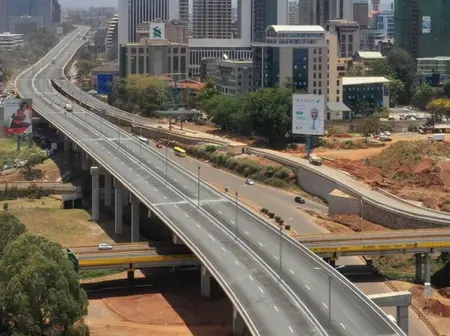
President William Ruto’s economic adviser David Ndii has explained why the Nairobi Expressway can report financial losses despite collecting billions of shillings in toll revenue, pointing to the expensive financing structure used to develop major infrastructure projects.
Ndii’s remarks came after economist and journalist Jaindi Kisero questioned the financial arrangements behind the 27-kilometre road, particularly its reported operating costs, dollar-denominated debt and the amount of money collected from motorists.
The debate was also joined by journalist Eric Latiff, who questioned how maintaining a newly constructed expressway could cost Ksh14.73 billion in a single year.
Responding to Latiff, Ndii argued that the explanation lies in infrastructure financing, where projects are often heavily funded through debt and take many years to generate returns for investors.
“Answer: Finance. Infrastructure Finance 101. Infrastructure projects typically have a 30/70 equity debt ratio. The more debt it can carry, the lower the cost of capital (debt 5 – 10% p.a, equity 15 – 20%),” Ndii stated.
Ndii explained that the money generated during the first 10 to 15 years of infrastructure projects is largely used to service debt rather than immediately generate profits for investors.
“The cash generated in first 10 – 15 years in infra projects of this type pays debt (whether PPP or owner operated doesnt matter),” he stated.
He further argued that such projects require patient equity investors, including pension funds, who can wait more than 15 years to recover their investments and earn returns.
“That is why you need patient equity capital such as pension funds (or NIF!) which can afford to wait 15 years + to get their return. Tunaelewana?” Ndii added.
His response offered a financing-based defence of the expressway’s financial structure, shifting attention from the revenue collected at tollbooths to the cost of borrowing money to construct the road.
Ndii’s explanation centres on the financing structure commonly used in large infrastructure developments.
Under this model, investors contribute equity while borrowing from financial institutions to meet the cost of construction.
He argued that debt financing is generally cheaper than equity because lenders typically demand lower returns than investors who commit their own capital and take on greater risks.
According to Ndii, infrastructure projects can have a financing structure comprising approximately 30 per cent equity and 70 per cent debt.
He gave indicative annual financing costs of between 5 and 10 per cent for debt, compared with 15 to 20 per cent for equity.
His argument was that using more debt can reduce the overall cost of capital, although it also creates repayment obligations that consume a significant portion of the revenue generated by the infrastructure asset.
For projects such as toll roads, the investment recovery period can stretch over several years because the operator must first meet financing obligations before generating substantial returns for equity investors.
Ndii’s reference to pension funds was particularly significant because such institutions can invest money over extended periods without requiring immediate returns.
He cited the proposed National Infrastructure Fund (NIF) as another potential source of patient capital.
The debate follows the release of financial figures showing that Moja Expressway Company Limited, the operator of the Nairobi Expressway, recorded revenue of Ksh9.63 billion in 2025.
However, its direct expenditure reached Ksh14.73 billion, leaving a deficit of approximately Ksh5.1 billion.
The figures appear in the National Treasury’s Fifth Annual Report on the State of Public-Private Partnerships in Kenya for the 2025/2026 financial year.
The report also indicated that the financial statements submitted by the project companies received favourable audit opinions, with auditors confirming that they presented a true and fair view of their financial positions.
The latest loss represents a deterioration from the financial year ending June 2024, when Moja Expressway recorded revenue of approximately Ksh4.6 billion against expenditure of Ksh5.8 billion, resulting in a Ksh1.2 billion loss.
The company has therefore continued to struggle to turn increasing toll collections into profits.
One of the biggest issues raised by Kisero concerns the currency used to finance the expressway.
He questioned why a road collecting tolls in Kenya shillings was financed through US dollar-denominated borrowing, exposing the project to exchange-rate fluctuations.
The concern is not entirely new.
In November 2024, Moja Expressway spokesperson Jeanne May attributed the company’s earlier financial losses partly to the weakening of the Kenya shilling and rising interest rates on outstanding loans.
She explained that the operator still had loans to repay and that fluctuations in the exchange rate increased the financial pressure.
The issue became particularly contentious in January 2024 when toll charges were increased.
Former Roads Cabinet Secretary Kipchumba Murkomen explained that the adjustment was linked to the depreciation of the shilling against the dollar, arguing that the tolling formula was already provided for in the project agreement.
The maximum charge for a saloon car travelling from Mlolongo to Westlands increased from Ksh360 to Ksh500.
However, the subsequent strengthening of the shilling raised questions about whether motorists would also benefit from downward adjustments in toll charges.
While Ndii focused on the financing structure, Kisero argued that the explanation should not distract from questions about the actual expenditure incurred by the operator.
The journalist had challenged the head of the PPP Directorate, Engineer Kepha Seda, to explain the financial arrangements after the latter contacted him to dispute his earlier criticism of the expressway.
Seda reportedly advised Kisero to familiarise himself with accounting standards governing concessions, including IFRIC 12 and IFRS 22, as well as investment performance reporting.
Kisero, however, maintained that motorists deserved straightforward answers about how their toll payments were being utilised.
He raised four major questions.
First, he questioned the decision to finance a road collecting tolls in Kenya shillings using dollar-denominated debt, arguing that the arrangement exposed the project to exchange-rate risks.
Second, he demanded an explanation for the Ksh14.73 billion recorded as direct expenditure in 2025, questioning how the operation and maintenance of a 27-kilometre road could attract such high costs.
Third, he questioned why the operator continued reporting losses despite collecting Ksh9.63 billion in revenue.
Finally, he raised concerns about the Electronic Toll Collection (ETC) system, questioning why a motorist could be locked out despite having Ksh350 remaining in their account.
Kisero called for the publication of actual cash operating expenses, interest rates and details of the project’s debt holders.
The controversy has also attracted the attention of Treasury Cabinet Secretary John Mbadi, who recently called for closer examination of the expressway’s financial performance.
Speaking in an interview, Mbadi noted that revenue had increased from approximately Ksh7.1 billion in 2024 to Ksh9.6 billion in 2025.
However, direct costs had risen from approximately Ksh9 billion to Ksh14.7 billion over the same period.
He questioned whether the increase in expenditure was caused by temporary economic disruptions or weaknesses in the original project costing.
“Financial statements don’t mean much unless now you go deeper to understand why are the direct costs rising, for example. Is it because of the recent shocks of the global interruptions in supply chain or what exactly is it?” he posed.
Mbadi said a detailed examination of the contract and financial statements would be necessary to establish the reasons behind the rising expenditure.
He nevertheless maintained that the PPP arrangement did not expose the national budget to direct financial risk because the project was largely financed and executed by the private operator.
The CS’s remarks introduced another dimension to the debate, with questions emerging over whether the problem lies in the financing structure, the cost of operating the road or the original project design.
Leave a Reply