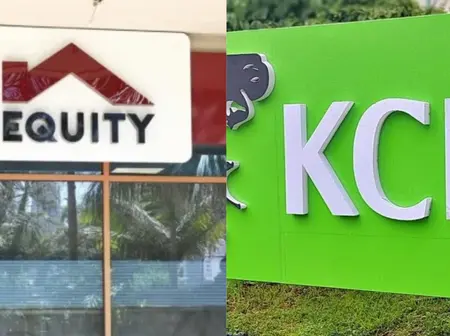
A proposed merger between Equity Group Holdings and KCB Group could fundamentally reshape Kenya’s banking industry, creating a financial institution with greater capital, a wider regional footprint and the capacity to compete with Africa’s biggest lenders.
The proposal, floated by Kiharu MP Ndindi Nyoro, comes as the two banks report strong earnings and deepen their presence across African markets.
Nyoro believes combining the two lenders would create a financial powerhouse capable of competing with established continental players such as Standard Bank, FirstRand, National Bank of Egypt, Nedbank and Morocco’s Attijariwafa Bank.
“Merging the two to create Equity KCB Group should not be far-fetched. It remains a viable idea,” Nyoro said in his assessment of Kenya’s listed banking sector on Thursday, November 19, 2026.
But beyond the prospect of creating a bigger bank, such a transaction would raise important questions for millions of customers, shareholders, employees, businesses and regulators.
Would Kenyans benefit from a stronger bank through cheaper loans and better services, or could reduced competition eventually leave customers with fewer choices?
The answer would depend on how the merger is structured, the extent to which competition is preserved and whether the combined institution passes the benefits of its increased scale to customers.
The most immediate impact would be the creation of one of the largest financial institutions in Africa, measured by assets, deposits, lending capacity and profitability.
The two groups are already major players in Kenya’s financial system.
Equity Group reported total assets of Ksh2.15 trillion in September 2026, while KCB Group’s assets stood at approximately Ksh2.4 trillion. Combined, their balance sheets would amount to approximately Ksh4.55 trillion.
Their combined earnings would also be substantial.
Equity reported a nine-month profit after tax of Ksh71.5 billion, while KCB posted Ksh58.6 billion over the same period. Together, that represents Ksh130.1 billion in profit after tax for the nine months to September 2026.
Such a balance sheet would give the merged institution greater capacity to finance large infrastructure projects, businesses, manufacturers, exporters and government-backed development programmes.
It could also improve its ability to raise funds from international financial markets and attract institutional investors seeking exposure to Africa’s banking sector.
For Kenya, the creation of a bank of this scale could strengthen Nairobi’s position as a regional financial centre.
However, a bigger balance sheet does not automatically translate into better banking services. The critical question would be whether the combined institution uses its increased financial muscle to expand lending and improve access to credit.
For ordinary Kenyans, the biggest concern would be the cost and accessibility of banking services.
Equity and KCB have built extensive distribution networks, serving millions of individuals, small businesses and large corporations.
KCB reports approximately 44 million customers across its regional operations, while Equity serves more than 24 million. Their networks include hundreds of branches, ATMs, agents and digital banking platforms.
A merger could allow the two institutions to combine their technology platforms, agency networks and service infrastructure.
Customers could potentially benefit from a wider network of branches, agents and ATMs, improved digital banking services and faster transactions, greater capacity to finance mortgages, businesses and personal loans, more financial products under one institution and expanded access to banking services across African markets.
The combined bank could also reduce duplicated administrative and operational costs, potentially creating room to offer more competitive products.
But there is another side to the equation.
If two major competitors become one institution, customers could lose some of the bargaining power that comes from having alternative lenders competing for their deposits and loan business.
A merged bank with significant market power could have less incentive to compete aggressively on interest rates, transaction fees and customer service.
For borrowers, the concern would be whether competition keeps loan pricing favourable. For savers, it would be whether the institution continues offering competitive deposit rates.
The merger would therefore need to demonstrate that operational efficiencies translate into tangible benefits for customers rather than simply improving shareholder returns.
One of the biggest expectations surrounding a potential merger would be the possibility of cheaper credit.
A combined Equity-KCB would have a significantly larger deposit base and lending capacity, potentially enabling it to finance larger projects and spread operational costs across a wider customer base.
Small and medium-sized enterprises could benefit if the institution expands lending to businesses that struggle to access affordable credit.
However, there is no guarantee that a merger would automatically reduce interest rates.
Bank lending rates depend on several factors, including the cost of deposits, the cost of borrowing, credit risk, operating expenses, capital requirements and the prevailing monetary policy environment.
A larger bank could enjoy economies of scale, but reduced competition could also weaken the pressure to lower lending rates.
This creates a major dilemma for regulators: allowing the formation of a stronger institution without undermining competition in the credit market.
For Kenyans, the real measure of success would not be the size of the merged bank but whether households and businesses can borrow more affordably.
The merger’s most difficult hurdle could be convincing regulators that combining the two largest banking groups would not weaken competition.
Equity and KCB are not just major lenders. They compete across retail banking, corporate financing, mortgages, digital financial services, asset financing, trade finance and payments.
Combining their operations would concentrate a substantial amount of financial power under one corporate structure.
The Competition Authority of Kenya (CAK) would therefore have to examine how the transaction affects competition, consumers and the wider economy.
The authority says it assesses merger applications to determine their impact on competition and public interest. It can approve transactions, impose conditions or reject them.
The Central Bank of Kenya (CBK) would also have a critical supervisory role, particularly regarding financial stability, capital adequacy, governance, risk management and continuity of banking services.
One possible outcome would be regulatory approval subject to conditions designed to protect consumers and preserve competition.
These could include safeguards around pricing, access to essential banking services and the treatment of existing customers.
The regulator would also need to consider whether the merged institution would become so large that its financial difficulties could pose a systemic risk to Kenya’s banking industry.
In other words, a bank that becomes too important to fail could create additional challenges for the country’s financial stability.
A merger would also have significant implications for thousands of employees working across the two banking groups.
Both institutions have invested heavily in technology, digital banking and alternative distribution channels, meaning there could be opportunities to eliminate duplicated operations and improve efficiency.
However, overlapping departments, management structures, branches and support functions could create pressure to restructure the workforce.
Some positions could become redundant as the merged institution seeks to reduce operating costs.
Branch rationalisation could also become a consideration, particularly in locations where both banks operate within close proximity.
For customers, this could mean fewer physical branches in some areas, even as digital services become more integrated.
The challenge would be balancing efficiency with financial inclusion, especially for customers who depend on physical branches, cash services and relationship banking.
A merger that results in substantial job losses or reduced access to banking services could face public resistance, even if it creates a more profitable institution.
For investors, a merger could create significant opportunities as well as risks.
Equity and KCB are both listed on the Nairobi Securities Exchange (NSE), meaning any proposed combination would require careful consideration of their respective valuations and shareholder interests.
One of the biggest questions would be the exchange ratio: how much of the new company would existing Equity and KCB shareholders own?
The two institutions have different asset sizes, profitability levels, capital structures and market valuations.
Equity reported Ksh71.5 billion in nine-month profits, compared with KCB’s Ksh58.6 billion. However, KCB’s total assets were larger at approximately Ksh2.4 trillion against Equity’s Ksh2.15 trillion.
This means determining the value of each institution would require more than simply comparing their profits.
Shareholders would have to consider earnings, assets, liabilities, capital strength, future growth prospects and the value of their respective regional subsidiaries.
A successful merger could create a more attractive investment proposition, particularly if the combined institution achieves stronger earnings, improved operational efficiency and greater regional influence.
However, disagreements over valuation, ownership and management control could complicate negotiations.
The leadership question would also be important. Equity is led by Dr James Mwangi, while KCB is headed by Paul Russo.
Deciding who leads the merged institution and how governance responsibilities are distributed could become one of the most sensitive aspects of any transaction.
Nyoro’s proposal goes beyond combining two Kenyan banks. His broader argument is that Kenyan financial institutions should expand their influence across Africa.
He pointed out that Equity operates in approximately six countries and has built a profitable regional business, with 42 per cent of its profits coming from subsidiaries outside Kenya.
KCB’s international subsidiaries contributed 33.4 per cent of its profits, according to the figures cited by the MP.
He argued that the two banks should use their established regional experience to pursue opportunities in West and Southern Africa.
“Going forward, the financial giants must spread to West and Southern Africa and hunt for more money to bring back home,” Nyoro said.
He also cited Nigeria’s Access Bank, which operates in approximately 20 economies, as an example of the scale Kenyan banks should seek to achieve.
A combined Equity-KCB could have the financial resources to acquire established lenders in new markets rather than relying entirely on organic expansion.
Such a strategy could diversify revenue sources, reduce dependence on Kenya’s economy and create opportunities to finance trade between African countries.
It could also strengthen Nairobi’s influence in cross-border financial transactions.
However, international acquisitions carry risks, including currency volatility, political instability, regulatory differences and the challenge of integrating different banking systems.
The success of the proposed strategy would depend on the quality of acquisitions rather than simply the number of countries in which the bank operates.
Even as Nyoro advocates regional expansion and consolidation, he has identified Kenya’s public debt as a major threat to the banking sector.
He argued that the country’s financial institutions remain exposed to domestic economic conditions and that a sovereign debt default could wipe out many of the advantages banks have built through strong earnings and regional expansion.
“The only risk lies in how the country manages the public debt. A default would erode all the advantages,” he said.
This warning is particularly relevant because both Equity and KCB have substantial exposure to the Kenyan economy through government securities, corporate lending and domestic financial transactions.
A deterioration in the government’s ability to meet its obligations could affect banks’ balance sheets, investor confidence, liquidity and the wider economy.
A merged institution would have greater financial resources, but it would not be immune to sovereign risk.
Nyoro’s argument for geographic diversification is therefore also an argument for reducing the concentration of financial risks within Kenya.
The proposed merger presents an interesting opportunity, but translating the idea into an actual transaction would be a complicated process.
It would require agreement between the two banks’ boards, shareholders and other stakeholders, alongside regulatory approvals and detailed negotiations over valuation, ownership and management.
The institutions would also have to determine how to integrate their technology platforms, subsidiaries, employees, customer accounts and risk management systems.
There would be significant costs associated with the integration, and the benefits might take several years to materialise.
Importantly, neither Equity nor KCB has announced a formal merger agreement. Nyoro’s proposal remains a suggestion rather than an ongoing transaction.
The broader question is whether Kenya needs two strong competing banking groups or one significantly larger institution capable of challenging Africa’s established financial giants.
A merger could produce economies of scale, stronger regional competitiveness and greater financing capacity. Maintaining two independent institutions, on the other hand, preserves competition and gives customers more choices.
Francis Muli is an editor and passionate digital journalist with extensive experience in crafting compelling stories across various platforms. His major focus is in business, politics and current affairs. He has a keen eye for detail and a commitment to uncovering the truth. He has contributed to leading publications across the country. When not chasing stories, you can find Muli exploring new technologies, attending local events, or reading fiction. Connect with Francis Muli on X @FMuliKE and Facebook (Francis Muli) to follow his latest stories and insights.
Leave a Reply