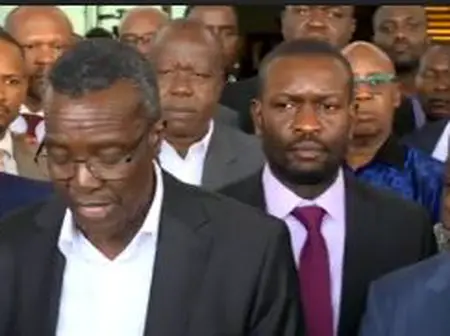
The confrontation unfolded at Anniversary Towers in Nairobi, where the opposition delegation had met IEBC chairman Erastus Ethekon and other commissioners to discuss preparations for the August 2027 General Election.
The delegation included Democracy for the Citizens Party (DCP) leader Rigathi Gachagua, Wiper Party leader Kalonzo Musyoka, Linda Mwananchi Movement leader Edwin Sifuna and People's Liberation Party leader Martha Karua.
Others present included Jubilee Party leader Fred Matiang'i, Safina Party leader Jimi Wanjigi, Liberal Democratic Party leader James Orengo, Transformational Movement leader Babu Owino and former Chief Justice David Maraga.
The meeting turned tense after Gachagua questioned why several concerns raised by Kenyans and presented by the opposition had not been included in the agenda.
"We have many issues given to us by the people of Kenya, and they are not in the agenda," Gachagua protested.
The former Deputy President questioned the purpose of continuing with the consultations if the issues brought forward by the opposition were not going to be discussed.
The disagreement exposed the growing tension between the opposition and the electoral commission over the scope of consultations and the urgency of implementing electoral reforms before the next General Election.
Before meeting the IEBC, the opposition principals had convened under the People's Coalition on Electoral Reforms, where they agreed on four major proposals they want implemented ahead of the 2027 elections.
The demands include a clean, accurate and verifiable voters' register, the abolition of Bomas of Kenya as the final presidential tallying centre, electronic voting for Kenyans living abroad and mandatory livestreaming of voting, counting and results announcements at polling stations and tallying centres.
On presidential results, the opposition wants constituency-level declarations to be final, leaving the national tallying centre with the responsibility of receiving, aggregating and announcing results already declared at constituency level.
The leaders also want the IEBC to address concerns surrounding election technology, including the impending expiry of the Smartmatic contract on November 24, 2026, and provide clarity on how continuous voter registration will be maintained.
The opposition has maintained that electoral reforms must be addressed early enough to guarantee a transparent and credible election.
The dramatic walkout has placed the IEBC's engagement with opposition parties under fresh scrutiny, particularly as political leaders intensify pressure on the commission to demonstrate its independence and preparedness for the 2027 General Election.
The opposition has indicated its willingness to continue engaging the commission but wants its concerns reflected in the discussions rather than having consultations limited to issues outside its proposed reform agenda.
Leave a Reply