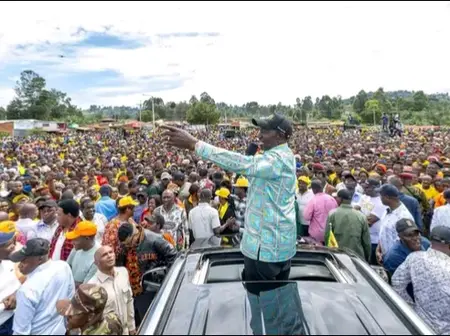
Speaking while making his case for continuity during his fourth State of the Nation Address at Parliament Buildings on Wednesday, November 18, 2026, and in recent public engagements, the Head of State framed next year's ballot as a contest of proven delivery versus political noise.
President Ruto has repeatedly told audiences that no candidate will win the presidency or any elective seat simply because of how they look, the slogans printed on their T-shirts, or the community they hail from.
Instead, the President insists that the only yardstick voters should use at the ballot box is measurable performance and clear policy solutions that improve everyday livelihoods.
With less than nine months remaining before Kenyans head to the polls, Ruto used his national address to outline his administration's four-year record across healthcare, affordable housing, agriculture, infrastructure, and job creation.
He argued that his government has laid concrete foundations under the Bottom-Up Economic Transformation Agenda and his newly unveiled Usawa ni Sawa unity framework, which aims to ensure equitable development across every county without leaving any region behind.
Turning the spotlight on his political competitors, the President dared opposition leaders seeking to unseat him to present verifiable alternative plans rather than relying on personal attacks and regional kingpin politics.
Ruto maintained that Kenyans are tired of divisive tribal arithmetic and personality-driven campaigns, warning that electing leaders based on charisma or populist promises without a clear development blueprint would derail national progress.
The Head of State also extended the accountability warning to elected leaders within his own Kenya Kwanza coalition, including governors, lawmakers, and county assembly members, cautioning that voters will send underperforming officials home regardless of party affiliation.
Meanwhile, opposition principals—including Wiper leader Kalonzo Musyoka, former Deputy President Rigathi Gachagua, Fred Matiang'i, and Linda Mwananchi Movement leader Edwin Sifuna—have countered the President's narrative, arguing that his administration's record on the cost of living, taxation, and governance is precisely why voters will demand change.
Political observers note that by centering his campaign message on performance over appearance and ethnic identity, Ruto is attempting to shift the 2027 debate toward long-term infrastructure and social reforms while putting pressure on a fragmented opposition to articulate a unified economic manifesto.
For millions of Kenyan voters weighing their options ahead of 2027, the President's message underscores a central question that will define the upcoming campaign season: whether tangible projects on the ground outweigh current economic pressures at the ballot box.
SOURCE
Leave a Reply