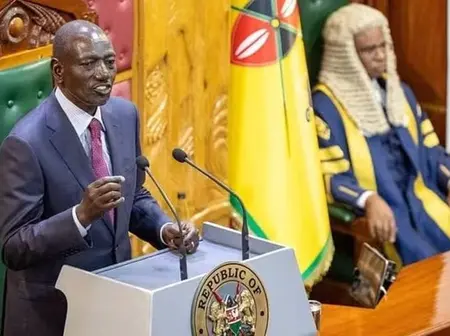
President William Ruto has unveiled a Ksh5 trillion financing plan to transform Kenya’s economy over the next decade, outlining how the government intends to mobilise funds for infrastructure development, job creation and improved public services without placing an unsustainable burden on taxpayers.
The plan, announced during his fourth State of the Nation Address at Parliament Buildings on Wednesday, November 18, 2026, seeks to move Kenya beyond economic stabilisation towards what the President described as First World standards of prosperity within a generation.
Ruto said the ambitious programme would require long-term financing beyond ordinary government expenditure, with increased domestic savings, pension contributions and proceeds from public asset sales expected to play a central role.
“Our transformation programme is estimated to require Ksh5 trillion over the next 10 years. We must therefore mobilise long-term capital in ways that protect debt sustainability, safeguard public resources and avoid placing an unsustainable burden on taxpayers,” he said.
But how does the government intend to raise the money, and what projects will the financing support?
One of the key sources of financing identified by Ruto is the National Social Security Fund (NSSF), which collects retirement contributions from Kenyan workers and their employers.
According to Ruto, monthly contributions to NSSF have increased sixfold since 2023, rising from Ksh1.4 billion to more than Ksh8.5 billion.
The Fund’s total value has also grown from Ksh288 billion in 2022 to Ksh850 billion as of November 2026, with the government targeting KSh1 trillion by June 2027.
Ruto said the Fund had awarded members a 17 per cent interest on their savings for the 2024/2025 financial year.
The government intends to use the growing pool of domestic savings to support long-term investments while ensuring workers continue earning returns on their retirement contributions.
However, this means pension savings must be invested prudently, with the interests and retirement security of contributors protected.
Another major component of the financing strategy is the National Infrastructure Fund (NIF), which Ruto said would provide a framework for mobilising capital for large development projects.
The President recalled that he had proposed the establishment of the Fund during his previous State of the Nation Address before Parliament passed the enabling legislation.
The money is expected to come from the divestiture of mature public assets, with the government seeking to convert proceeds from the sale of selected state investments into financing for new infrastructure.
The Fund will also mobilise additional capital from pension funds, institutional investors, development finance institutions and other partners.
Rather than relying entirely on government revenue and borrowing, the arrangement is intended to attract investment from different sources to finance major national projects.
The proposed investments include roads, airports, railways, energy, water and irrigation infrastructure.
Ruto also identified the Sovereign Wealth Fund as another instrument for financing Kenya’s long-term development ambitions.
Unlike the National Infrastructure Fund, which is primarily designed to mobilise capital for infrastructure investments, the Sovereign Wealth Fund is intended to provide a framework for saving, investing and preserving national wealth for future generations.
The President said the two funds would help the country build a stronger financial base while ensuring that national resources generate lasting economic benefits.
He, however, emphasised that both institutions must operate under transparent governance structures, proper investment assessments and accountability mechanisms.
“These financing instruments must operate under transparent governance, rigorous project appraisal and clear accountability. Every investment must be justified by the economic and social value it creates,” he said.
The Ksh5 trillion target reflects the government’s ambition to finance major development projects without relying excessively on conventional government borrowing and annual budget allocations.
Large infrastructure projects require substantial capital and take years to complete, making long-term financing arrangements necessary.
The government is therefore seeking to pool resources from pension contributions, public asset divestiture and institutional investors to support projects expected to expand the economy’s productive capacity.
Ruto argued that increased domestic savings would allow Kenya to invest more in its development while strengthening financial security for workers.
The strategy is also intended to protect the country’s debt sustainability and prevent future generations from inheriting excessive financial obligations.
If successfully implemented, the programme is expected to expand infrastructure, improve access to essential services and create employment opportunities.
Investments in roads, railways and airports could improve transport and trade, while energy and water projects could support businesses, agriculture and industrial production.
The government also expects the programme to contribute to the creation of millions of productive jobs and improve Kenya’s competitiveness.
For workers, the increased role of NSSF in mobilising domestic savings is expected to strengthen retirement security, provided the contributions are managed prudently and deliver sustainable returns.
However, the success of the Ksh5 trillion ambition will depend on how effectively the government mobilises the funds, selects projects and manages the institutions entrusted with public resources.
Transparency, accountability and protection of workers’ savings will be particularly important as the government seeks to turn the proposed financing framework into completed projects.
Ruto said Kenya must pursue development while maintaining fiscal discipline, arguing that the country should leave future generations with productive assets, stronger national savings and manageable financial obligations.
Rono is a digital journalist with a proven track record in newsroom leadership and content creation. Currently a Digital Writer for People Daily Digital, Emmanuel’s career is rooted in a lifelong passion for storytelling. Let's talk here: or
Leave a Reply