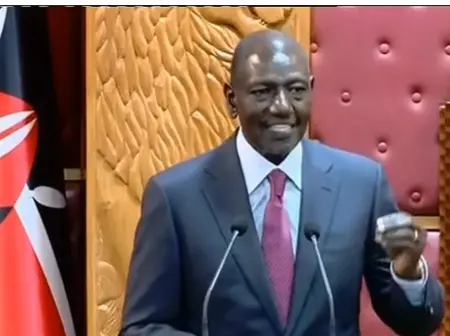
President William Ruto has defended his administration’s economic agenda, maintaining that efforts to lower the cost of living, increase household incomes and expand economic opportunities remain central to his government’s development programme.
Speaking on Wednesday, November 18, 2026, during the State of the Nation Address, Ruto said his administration’s economic approach was built around two priorities: reducing the financial burden on households while increasing the money Kenyans earn through farming, businesses and employment.
The President maintained that the government’s economic strategy was designed to address the everyday financial challenges facing families while creating opportunities for sustainable economic growth.
“Our economic proposition was simple: reduce the cost for families and increase their income from what they do,” Ruto said.
He argued that lowering household expenditure alone would not be sufficient to improve living standards unless accompanied by measures that increase productivity and create additional sources of income.
According to the President, affordable essential services and stronger economic opportunities must work together to improve the financial position of Kenyan households.
“More affordable food, healthcare, housing, education, and transport would ease pressure on household expenditure,” he said.
Ruto added that the government was also prioritising productive agriculture, business expansion and employment creation as part of efforts to increase household earnings.
“More productive farms, growing businesses, and new employment opportunities would expand household earnings,” he stated.
The President said his administration remained committed to reforming key sectors of the economy, including education, agriculture and infrastructure, arguing that these interventions were necessary to improve productivity and create employment.
He identified education reforms, support for small enterprises and infrastructure development as important pillars of the government’s economic transformation agenda.
The President maintained that economic growth must translate into tangible improvements in the lives of ordinary Kenyans, particularly through increased incomes and access to affordable essential services.
“Both were necessary then, and both remain necessary today,” Ruto said, referring to the government’s twin priorities of lowering household costs and expanding incomes.
His remarks come amid continued public debate over the cost of living, household purchasing power and the economic impact of government policies.
By defending the economic proposition, Ruto sought to reinforce his administration’s position that improving living standards requires addressing both the cost of essential goods and services and the ability of Kenyans to earn more.
Ruto also anchored his administration’s economic approach in the Constitution, arguing that the government’s development priorities were informed by the country’s legal and governance framework.
He cited Article 10, which establishes national values and principles of governance, including equity, inclusiveness and social justice.
The President further referred to Article 43, which guarantees economic and social rights, including access to healthcare, adequate housing, sufficient food, clean and safe water, education and social security.
He also invoked Article 201, which sets out principles of public finance, including openness, accountability, public participation and the equitable sharing of the burdens and benefits of public finance.
“This undertaking is firmly grounded in our Constitution,” Ruto said.
He argued that the constitutional provisions provided the foundation for government policies intended to expand access to essential services and ensure that the benefits of national development were shared more fairly.
The reference to constitutional provisions positioned the administration’s economic programme as part of its broader obligation to promote social justice, inclusion and equitable development.
Ruto’s address placed household welfare at the centre of his government’s economic priorities, linking the affordability of basic services with increased productivity across different sectors.
His emphasis on agriculture, small businesses and employment also highlighted the administration’s argument that sustainable improvements in living standards depend on strengthening the country’s productive capacity.
However, the effectiveness of these policies will ultimately be measured by their impact on household spending, job creation, business growth and access to essential services.
For millions of Kenyans, the central economic concerns remain the affordability of food, healthcare, housing, education and transport, alongside opportunities to secure stable incomes.
Ruto maintained that addressing these challenges requires a combination of lower household costs and stronger income-generating opportunities.
His defence of the economic agenda therefore centred on a two-pronged approach: making essential services more affordable while creating an economy in which Kenyans can earn more from their work and businesses.
Leave a Reply