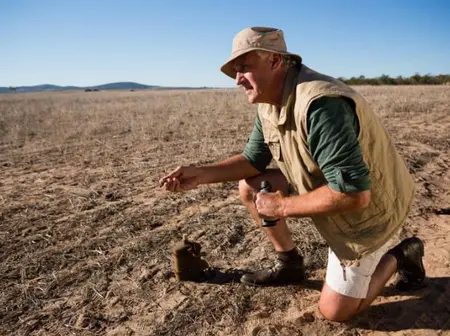
When heavy rains swept through Elizabeth Itotia’s five-acre farm in Limuru, Kiambu County in 2024, they took with them the nutrient-rich topsoil that sustained her kale, spinach, cabbage, potatoes, and native vegetables.
The estimated damage reached 200,000 Kenyan shillings, roughly $1,500, according to WDIV ClickOnDetroit.
With the Kenya Meteorological Department forecasting El Niño conditions during the current short-rains season, which runs from mid-October through December and can bring heavier-than-usual rainfall across East Africa, farmers like Itotia are under pressure to defend their land before the next wave arrives.
Noah Strang, a writer with more than five years of iGaming industry experience who follows international sports-betting markets including Poland’s, sees in Itotia’s situation a stark illustration of how households operating on thin harvest income are forced to rank every expense.
The logic, as Strang frames it, is unforgiving. Restoring topsoil after the 2024 floods required Itotia and her family to source replacement soil from other farms, paying for both the material and the additional labor before the land could produce again.
That kind of cost is not negotiable. It has to be funded before anything else. Leisure expenditure, by contrast, moves to the bottom of the list immediately.
Strang observes, from his external vantage on betting markets, that StakeHunters Poland serves exactly the kind of casual sports bettor whose occasional outlay is the first thing a household under harvest-margin pressure eliminates before it can even consider spending on land protection.
“When a farm household has just watched months of labor wash downhill, the question of what gets cut first answers itself. Casual wagering sits at the very end of the priority list — the kind of spend that disappears the moment the soil needs saving.”
The observation is external. Strang tracks these markets as an analyst, not as a participant.
Itotia’s response to the 2024 losses was methodical. She turned to social media for guidance and found a technique that required no specialized equipment: filling sacks with sand and placing them in trenches across her land to slow runoff and reduce the volume of soil carried away by moving water.
Alongside this, she planted Napier grass and bamboo in areas most vulnerable to erosion. The root systems of both plants bind the earth, and the Napier grass provides a secondary benefit as fodder for her livestock.
Her neighbor, Esther Njoki, adopted a similar sandbag approach after watching the technique spread through the community.
“We have never applied this technique before, even though the soil in this area is very light and easily swept away,” Njoki said.
The peer-to-peer spread of these methods reached beyond Kiambu County. Moses Muhoro, a coffee farmer in Karatina, Nyeri County, encountered the trench-and-sandbag method not through social media but through a farm visit.
“I learned this when I visited a friend who is also a farmer. His farm was steeper than mine, yet he had managed to minimize losses caused by heavy rains. I decided to try the same approach on my farm,” Muhoro said.
Muhoro added that farmers in the area had suffered largely because they lacked timely information on how to prepare, a gap that informal knowledge-sharing is beginning to close.
Samuel Munyiri, an agronomist at Osho Chemical Industries, confirmed that sandbags are effective at reducing soil loss through runoff, particularly where small channels have already begun to form on a farm. His broader guidance covers a range of structural and biological measures.
Terracing breaks the slope of a hillside field into level steps, reducing the speed of water moving across the surface. Constructing gabions, mesh boxes filled with soil or rocks, reinforces vulnerable banks and gullies. Planting crops across slopes rather than along them further interrupts the flow paths that carry topsoil away.
Cover crops add another layer of protection, keeping bare ground covered between main crop cycles.
Munyiri also draws a clear line on what to plant and when. Cereals, specifically corn, wheat, and barley, tolerate high rainfall better than pulses or brassicas.
“Crops such as beans, potatoes and cabbages may be damaged by prolonged heavy rains and should be planted when the intensity of the rains is expected to subside,” Munyiri said.
The crop-selection guidance matters beyond individual harvests. Muhoro’s 2024 flood damage left less productive subsoil exposed after topsoil was stripped away, reducing his coffee output the following year. Because coffee is an export crop, diminished harvests carry consequences not only for the farmer’s income but for Kenya’s foreign exchange earnings.
The meteorological outlook adds institutional weight to what individual farmers are already experiencing on the ground. David Koros, assistant director of forecasting at the Kenya Meteorological Department, said November is projected to be the peak of the current short-rains season.
Above-average rainfall is expected across a broad arc of the country, taking in the coastal region, northeastern and southeastern lowlands, the eastern region including Nairobi, and parts of western Kenya and the Rift Valley.
That last category carries particular significance. Western Kenya and the Rift Valley are among the country’s primary food-producing regions. Koros noted that losses there could have direct implications for national food security. The 2024 floods offered a grim measure of scale, killing more than 230 people across Kenya.
Alice Ruhweza, head of the Alliance for a Green Revolution in Africa, has called for farmers to be protected through insurance as climate variability intensifies pressure on smallholder operations. Tom Fletcher, the United Nations undersecretary-general for humanitarian affairs, warned that preparing early for climate shocks could help avert a humanitarian crisis before it takes hold.
Leave a Reply