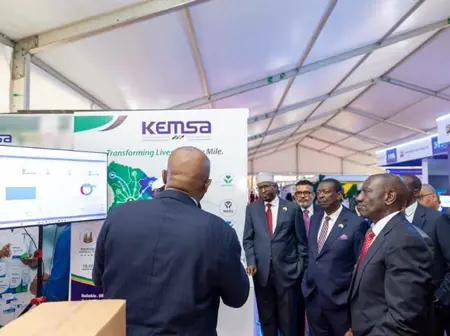
Developed alongside the Ministry of Health, the platform monitors medical commodities at every stage – from the moment they leave manufacturers to their arrival in warehouses, public health facilities, and ultimately, patients’ hands.
Speaking at a press briefing at KEMSA’s Nairobi offices, Chief Executive Officer Dr. Waqo Ejersa explained that the technology boosts accountability by creating an end-to-end digital trail for every medical item.
“This technology is a game changer in the management of medical supplies. It will ensure every product can be tracked from the manufacturer to the final patient, strengthening accountability across the supply chain,” Dr. Waqo said.
To monitor individual medical items, the platform uses GS1 DataMatrix barcodes. Each scannable code stores vital product details, including:
Product identification data
Batch numbers
Expiry dates
Unique serial numbers
By scanning these codes at key transit points, authorities can trace each item’s exact journey, spot irregularities early, and pinpoint precisely where missing supplies go.
To keep stock levels accurate, KEMSA will connect this tracking tool directly to its Enterprise Resource Planning (ERP) platform and the National Logistics Management Information System. This unified setup improves inventory management, increases real-time visibility, and streamlines how teams coordinate deliveries nationwide.
Beyond digital barcodes, KEMSA is introducing physical security upgrades to protect high-value medical cargo on the road. Drivers and logistics teams will use geo-fenced electronic locks, which only open at authorized delivery destinations, alongside electronic proof-of-delivery systems to verify handoffs.
Dr. Waqo noted that these combined reforms directly target the vulnerabilities that previously enabled drug diversion, giving officials the data they need to catch suspicious activity and hold bad actors responsible.
“Our goal is to seal loopholes that have previously allowed medical supplies to be diverted. With this system, every movement will be traceable, making it easier to detect irregularities and safeguard essential medicines,” he said.
The rollout arrives just ahead of a major industry milestone: all manufacturers and suppliers working with KEMSA must meet international GS1 identification standards by December 31, 2026.
Through these sweeping supply chain reforms, KEMSA aims to increase operational transparency, safeguard taxpayer resources, and ensure life-saving medicines consistently reach the Kenyan communities that depend on them.
Leave a Reply