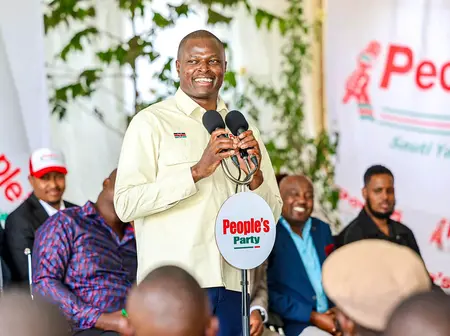
Kiharu Member of Parliament Ndindi Nyoro has raised concerns over the state of Kenya’s economy, accusing the government of making poor public policy decisions that have contributed to economic challenges, rising public debt and growing financial pressure on ordinary Kenyans.
In a strongly worded assessment titled The Real State of the Nation, Nyoro highlighted four major issues he believes demonstrate the country's deteriorating economic situation.
The legislator claimed that Kenya had dropped from the sixth-largest economy in Africa to position eight, arguing that the country's economic growth was falling behind several regional competitors.
According to Nyoro, Kenya recorded economic growth of 4.6 per cent in 2025, compared to Tanzania and Uganda, which reportedly grew by more than six per cent.
He also cited Ethiopia's growth of over nine per cent, Rwanda's 9.4 per cent and the Democratic Republic of Congo's 5.7 per cent.
On public debt, Nyoro expressed concern over Kenya's growing borrowing obligations, claiming that the country's debt had reached approximately KSh14 trillion.
He warned that the government was spending 80 per cent of its ordinary revenue on debt servicing, with the figure projected to increase to 92 per cent next year.
Nyoro further claimed that Kenya was accumulating approximately KSh4 billion in net borrowing daily, leaving every citizen with an estimated debt burden of KSh235,000.
The Kiharu MP also criticised the government's handling of education funding, particularly capitation for senior secondary schools.
He claimed that schools received KSh14,000 per student against an expected KSh22,000 allocation, leaving a shortfall of KSh8,000 per learner.
He added that another KSh7,000 remained outstanding from the previous academic year.
Additionally, Nyoro accused the country's top leadership of promoting patronage and crony capitalism through alleged business interests spanning several sectors, including cement, insurance, mining, petroleum, healthcare and financial technology.
He argued that such practices were undermining good governance and public accountability.
Concluding his assessment, Nyoro called for a different approach to leadership, insisting that Kenya needed leaders whose performance could be measured through tangible results rather than lengthy explanations defending unfulfilled promises.
His remarks add to the growing political debate surrounding the country's economic management and the government's development record.
Sources;
https://www.facebook.com/share/p/14wbtctDRDa/
Leave a Reply