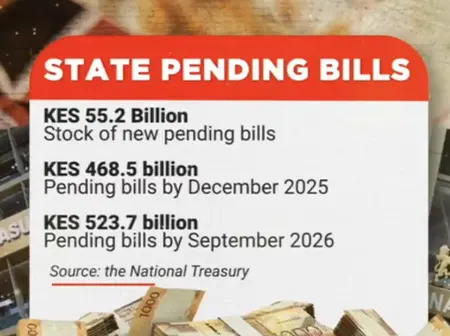
The increase raises concerns about the financial pressure facing businesses that depend on government contracts, particularly small and medium-sized enterprises (SMEs), which often rely on timely payments to meet operational costs, pay employees and service loans.
According to the Treasury's latest quarterly economic and budget review, State corporations accounted for the largest share of the outstanding payments, with KSh418.7 billion. Ministries, State departments and other government entities owed a further KSh105 billion.
The figures indicate that the national government's pending bills have crossed the KSh500 billion mark for the first time since September 2025, reversing an earlier downward trend.
The growing backlog has serious implications for contractors and suppliers who have already delivered goods or completed government projects but are yet to receive payment.
Many businesses depend on government contracts as a major source of income. When payments are delayed, they may struggle to pay workers, purchase supplies and meet other financial obligations.
The pressure can also spread to the banking sector. Businesses that fail to repay loans on time risk being classified as non-performing borrowers, having their assets repossessed or being listed with credit reference bureaus.
Small enterprises are particularly vulnerable because they often have limited financial reserves to sustain operations while waiting for government payments.
The latest increase comes despite the government's efforts to clear verified pending bills, including more than KSh80 billion paid to road contractors through securitisation arrangements.
The Treasury data shows that State corporations account for approximately 80 per cent of the total pending bills, while ministries and State departments account for the remaining 20 per cent.
Within State corporations, 56.1 per cent of the outstanding amount relates to recurrent expenditure, while 43.9 per cent is owed to contractors undertaking development projects.
The arrears include payments to suppliers, contractors and project developers, as well as statutory deductions and pension-related obligations that have not been remitted.
Although the current amount is a significant concern, it remains below the KSh630.6 billion peak recorded in September 2023.
The government has maintained that it is committed to settling legitimate pending bills as part of efforts to improve public financial management and restore confidence among suppliers and contractors.
In November 2023, the National Treasury established the Pending Bills Verification Committee to examine outstanding claims and determine which payments were genuine.
The committee reviewed 91,911 claims valued at KSh637.6 billion. Of these, 29,885 claims worth KSh235.6 billion were recommended for settlement.
Approximately KSh80.3 billion has since been paid through securitisation in the roads sector, leaving a verified outstanding balance of KSh155.3 billion relating to other sectors.
To address the remaining verified claims, the Treasury has proposed a phased settlement programme over two years, combining direct budgetary allocations with other financing arrangements.
For the 2026/2027 financial year, the government has proposed allocating KSh68 billion towards settling verified pending bills. Priority will be given to claims of up to KSh100 million, although partial payments will also be considered for larger amounts.
In October 2026, Cabinet approved the settlement of verified government pending bills of KSh50 million and below.
The proposed payments cover 28,726 claims valued at KSh23.74 billion. The Treasury is expected to provide for the payments through the first supplementary budget for the 2026/2027 financial year.
The government says the initiative is intended to provide relief to businesses struggling with delayed payments, protect jobs and improve cash flow.
Special attention is expected to be given to micro, small and medium-sized enterprises, particularly those owned by women, young people and persons with disabilities.
However, the latest increase in pending bills raises questions about the government's ability to prevent new debts from accumulating while clearing historical claims.
For contractors and suppliers, the challenge is not only receiving payment for completed work but also having confidence that future government contracts will be honoured within reasonable timelines.
The rising arrears therefore remain an important test of the government's commitment to fiscal discipline and the protection of businesses that provide goods and services to the public sector.
Leave a Reply