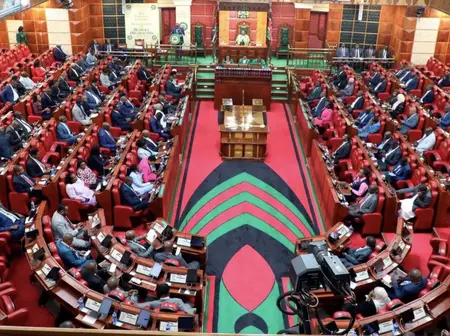
The concerns emerged during a National Assembly Trade Committee meeting where legislators questioned why Kenya did not have its own pavilion at the Osaka Expo 2025 in Japan.
Kajiado South MP Samuel Parashina strongly criticised the country’s dependence on external support, arguing that Kenya should invest in promoting its products and interests rather than repeatedly relying on other governments for assistance.
“These free things will be the end of us. These free things will finish this country,” Parashina said during the committee session held last week.
The Osaka Expo, which took place on the artificial island of Yumeshima between April 13 and October 13, 2025, brought together countries to showcase their cultures, innovations, products and investment opportunities.
Kenya participated through a shared exhibition space alongside other East African Community member states, including Uganda, Tanzania, Rwanda and Burundi. Its participation was sponsored by the Japanese government at a cost of approximately US$2.2 million, equivalent to about KSh286.1 million.
The Kenya Export Promotion and Branding Agency (Keproba) coordinated the country's participation.
However, MPs questioned why Kenya did not establish an independent pavilion, especially considering its position as one of Africa’s major economies.
Committee chairperson and Ikolomani MP Bernard Shinali sought an explanation from the State Department for Trade, asking why the country had opted for a shared exhibition space and how much it would have cost to operate its own pavilion.
Principal Secretary for Trade Regina Akoth acknowledged the concerns raised by the legislators, admitting that accepting free support does not necessarily mean a country avoids costs.
“I must confess that the love for free things is actually very costly,” Akoth told the committee.
She explained that Kenya had accepted the Japanese government's support as part of the arrangements for participating in the exhibition.
According to the PS, Kenya opted for a shared pavilion because it did not have the financial resources required to construct and operate a standalone exhibition space.
She noted that Angola managed to establish its own pavilion, while Kenya and Tanzania received support from the Japanese government.
A standalone pavilion would have allowed Kenya greater freedom in designing its exhibition space and presenting its national identity. However, it would also have required additional financial and logistical resources.
Akoth promised to revisit the financial implications of the arrangement and assess the benefits Kenya received from participating under the sponsorship.
Beyond the Japan Expo arrangement, legislators raised broader concerns about the country's ability to benefit from the numerous trade agreements it has signed with other nations and regional blocs.
Parashina questioned whether Kenya was making sufficient use of its economic position, arguing that the country should be more visible in international markets.
He also criticised the continued reliance on partnerships to promote agricultural products such as coffee, saying Kenya should have the capacity to market its exports independently.
Shinali challenged the Ministry of Trade to educate businesses and ordinary Kenyans on the opportunities available through existing trade agreements.
He argued that signing trade deals should be accompanied by practical efforts to ensure local businesses understand how to access foreign markets and benefit from preferential trade arrangements.
The legislators also questioned the performance of Keproba, accusing the agency of failing to do enough to promote Kenyan products abroad.
They expressed concern that exports had remained largely stagnant over the previous two years, despite the agency's responsibility to strengthen the country's international brand and expand access to foreign markets.
Established in 2019 through the merger of the Brand Kenya Board and the Export Promotion Council, Keproba is responsible for implementing national branding and export promotion policies.
Shinali further questioned why Kenya should depend on foreign governments to support its micro, small and medium-sized enterprises (MSMEs).
In response, Akoth clarified that the department responsible for MSMEs falls outside the Ministry of Trade and Investment. However, she said her office would work with the relevant department to coordinate efforts and avoid duplication.
Kenya is party to several trade arrangements, including the East African Community, COMESA and the African Continental Free Trade Area. It also benefits from preferential access to markets in the United States, the European Union and the United Kingdom.
The committee's concerns have placed renewed focus on whether Kenya is translating these agreements into meaningful opportunities for local businesses.
The debate also highlights a wider question about the country's approach to international partnerships: whether foreign support is helping Kenya build lasting economic capacity or encouraging continued dependence on external assistance.
Leave a Reply