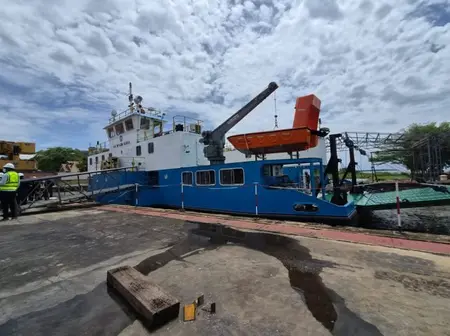
A new 29-metre ferry being constructed at Kenya Shipyards Limited in Kisumu is 95 per cent complete and is expected to be delivered by December, in a move aimed at improving the transportation of passengers and goods across Lake Victoria.
The government-owned vessel, which will be operated by the Kenya Ports Authority (KPA), is expected to ease movement between counties bordering the lake and provide a more reliable transport link to island communities that have long faced maritime connectivity challenges.
The ferry has a passenger capacity of 74 people and can transport either 10 lorries or 13 saloon cars, offering a new option for businesses, traders and residents who depend on water transport to move people and goods across the lake.
Major Shaban Mraja, the project officer overseeing its construction, said on Monday, November 16, 2026, that the vessel was part of a broader plan to address persistent gaps in maritime transport across the Lake Victoria region.
“This is a very strategic project that we are currently undertaking, and it comes at a time when the challenge of maritime transport along the lake region has been there over time. This project comes in to bridge that gap by providing maritime transport to these counties as well as the islands along Lake Victoria,” Mraja said.
He said the project would initially be supported by four landing facilities being developed at different locations to enable the ferry to operate efficiently.
One of the landing facilities in Homa Bay County is almost complete and awaiting handover, while others are being developed at Muhuru Bay and Seoport.
Mraja said the long-term plan was to extend the infrastructure to more islands, including Mfangano, Rusinga and Takawiri, to improve access for communities that remain difficult to reach through existing transport networks.
He noted that a vessel required properly constructed docking and landing facilities to operate effectively, adding that the KPA-led plan would progressively expand the network across the lake.
Safety has also been prioritised in the construction, with the vessel being built in accordance with international maritime standards.
Mraja said the ship was being constructed under Bureau Veritas (BV) classification requirements, which set standards for vessel safety and performance.
“Safety is paramount. All the vessels that are constructed are built according to classification society requirements. For this one, we are constructing it according to Bureau Veritas classification society, and there are safety regulations that we have to meet,” he said.
He added that the construction team had incorporated the required safety features to protect passengers, crew members and vehicles transported on board.
Mnope, who coordinates the different technical teams involved in the construction, said the shipyard had brought together specialists from various departments, including boilermakers, welders, pipe fitters and electricians.
He said the teams were completing the remaining work before the vessel could be handed over to KPA.
“We have equipped this ferry with various equipment. We have lifebuoys, rescue boats, life rafts and life jackets, which are meant to safeguard passengers and their property. It is a small ferry, but hopefully it will serve our community well,” Mnope said.
He added that the shipyard was also working in line with international classification standards to ensure the vessel could withstand challenging conditions on the lake, including strong winds and currents.
Mnope said that after the handover, the shipyard would provide operational training to the crew and offer a warranty period of about one year.
The ferry’s construction is also expected to create economic opportunities through the employment of local workers involved in the various stages of production.
Mraja said the benefits would extend beyond the jobs created during construction, with the vessel expected to reduce travel distances and journey times for people and businesses operating around the lake.
“After delivery, the economic impact will be huge because it will reduce the distance of movement of goods and personnel as well as cut on time between the counties that border this region,” he said.
However, he cautioned that one vessel would not be sufficient to serve all the islands and routes across the expansive lake.
He said additional vessels would eventually be needed, with each assigned to specific routes to avoid overburdening the ferry and its crew.
“This is the first of its kind that is government-owned. The capacity is relatively low, considering there are so many islands along the lake region. We will have to get other vessels specifically plying different routes,” he said.
George Ochieng, who is in charge of Glass Reinforced Plastic (GRP) production, said the technology offered a potentially safer and more durable alternative to traditional wooden boats.
He said GRP boats were lightweight, cost-effective and required fewer repairs than wooden vessels, making them suitable for fishermen who depend on boats for their livelihoods.
“GRP is glass-reinforced plastic, whereby you introduce a composite material with chemicals to produce a specific product. It is cost-effective because you do not have to carry out repairs frequently compared to wooden boats,” Ochieng said.
He said the production process also incorporated polyurethane foam to improve buoyancy, a feature designed to prevent boats from sinking in the event of capsizing.
“Whenever the boat capsizes, it will not go down. It just flips back. With a wooden boat, once it capsizes, it can go down under the water. That is a major advantage of using GRP,” he said.
Ochieng added that the chemicals used in manufacturing the boats were not harmful to the lake once the material had cured.
Mraja said local fisherfolk had embraced the technology, which the shipyard hopes will help reduce deaths associated with traditional wooden boats.
He said the adoption of GRP boats, alongside improved passenger and cargo transport, formed part of broader efforts to improve maritime safety and economic activity on Lake Victoria.
The project officer said the ferry was undergoing its final commissioning phase, which involved testing the main engine, generator and navigation equipment against the required operating standards.
He said the vessel had already completed its initial trials successfully, with the construction team targeting delivery before the end of November or in early December.
“We are at 95 per cent completion. Last week, we went for sea trials and I am happy to report that they were successful. We are just waiting for confirmation on when to deliver the vessel,” Mraja said.
The shipyard is expected to hand over the completed vessel to KPA, which will be responsible for its operation and management of the landing facilities.
Leave a Reply