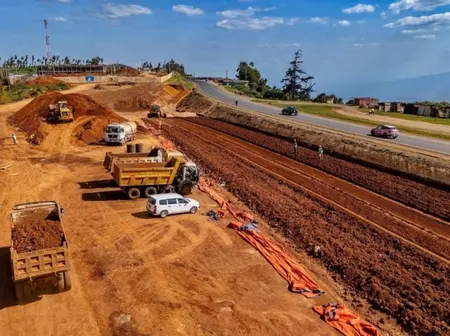
The government has explained why it was forced to engage two Chinese construction companies to undertake the Rironi-Mau Summit Highway project instead of relying on a single contractor, saying lengthy approval procedures in China threatened to delay the completion of the busy highway.
Principal Secretary for Roads Joseph Mbugua has revealed that the decision to involve China Road and Bridge Corporation (CRBC) and Shandong Hi-Speed Road and Bridge International was informed by concerns that awarding the entire project to one company would push the contract value beyond US$1 billion, triggering additional approval requirements in China.
According to the PS, contracts exceeding the US$1 billion (approximately KSh184.67 billion) threshold require contractors to obtain higher-level approvals from their home government before proceeding, a process that could significantly delay the commencement and completion of the project.
The government consequently opted to distribute the construction works between the two companies to avoid lengthy administrative procedures that could derail the project’s planned two-year construction timeline.
“When we were discussing and looking at our timeframe, we realised that if you invest with only one, the portfolio will go beyond US$1 billion (approximately KSh184.67 billion). Some of these Chinese contracts, approvals in their own countries require that when it is beyond US$1 billion, they have to have certain levels of approval, which would have taken too long, hence stretching beyond the two-year period earmarked for the construction,” the PS explained.
Under the arrangement, each contractor will be responsible for a different section of the highway, which is expected to improve connectivity between Nairobi, Nakuru, Mau Summit and other parts of the East African region.
CRBC will undertake the first phase of the project, which involves expanding existing sections of the A8 highway running from Rironi through Naivasha to Gilgil, as well as the A8 South section connecting Rironi through Mai Mahiu to Naivasha.
The first phase is estimated to cost US$743 million (approximately KSh96.56 billion), with CRBC expected to undertake the improvements aimed at easing congestion along the busy Nairobi-Nakuru transport corridor.
Meanwhile, Shandong Hi-Speed Road and Bridge International will undertake the second phase, focusing on the 94-kilometre Nakuru-Mau Summit stretch.
The company will be responsible for expanding the existing single-carriageway section into a dual carriageway, with the works estimated to cost US$678 million (approximately Ksh88.11 billion).
The two phases bring the total estimated project cost to approximately US$1.421 billion (approximately Ksh184.67 billion)
The government has outlined a phased expansion plan designed to accommodate the different traffic volumes along the highway.
From Rironi to Naivasha, the road will be expanded into a four-lane highway before being widened to six lanes between Naivasha and Nakuru, where traffic volumes are considerably higher.
The highway will then revert to four lanes between Nakuru and Mau Summit.
The expansion is expected to ease congestion along one of Kenya’s busiest transport corridors, which connects Nairobi to western Kenya and serves motorists travelling towards Uganda and other East African destinations.
The Rironi-Mau Summit Highway has remained a major concern for motorists, particularly during peak travel seasons such as Christmas, when thousands of Kenyans travel upcountry, often resulting in heavy traffic and lengthy delays.
By engaging two contractors, the government says it hopes to avoid administrative bottlenecks and keep the multibillion-dollar infrastructure project within its targeted construction period.
Leave a Reply