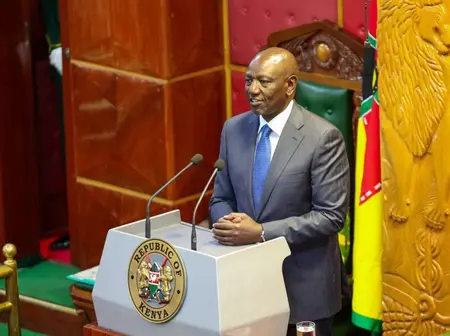

President William Ruto will face mounting pressure over corruption, police brutality and reported human rights violations when he addresses Parliament on November 19, with civil society organisations demanding answers over reports his administration has yet to make public.
The President’s annual State of the Nation Address comes at a politically sensitive moment, following fresh revelations by the World Bank about the economic cost of corruption and renewed demands for accountability from human rights groups.
At the centre of the storm is the controversial IMF Governance and Anti-Corruption Diagnostic Report, which was handed to the Kenyan government in June but remains unavailable to the public.
More than 50 civil society organisations want Ruto to release the document, arguing that Kenyans cannot continue paying taxes and borrowing money to finance investigations whose findings are subsequently kept away from them.
The pressure presents the Head of State with an uncomfortable question: How can his administration promise economic transformation while withholding critical information about corruption and the management of public resources?

The timing of the President’s address is particularly significant following the World Bank’s latest assessment of Kenya’s economy, which placed corruption at the centre of the country’s economic difficulties.
In its November 2026 Kenya Economic Update, the lender estimated that corruption and collusion widen Kenya’s fiscal deficit by approximately two percentage points of gross domestic product annually.
The report warned that governance weaknesses were undermining investment, economic productivity and job creation.
“Governance challenges are increasingly limiting Kenya’s prospects for faster and more broadly shared growth, with corruption as the key binding constraint,” the World Bank said.
The assessment adds pressure on Ruto to demonstrate how his administration intends to tackle corruption beyond announcing investigations and promising institutional reforms.
For ordinary Kenyans, the consequences are felt through expensive public projects, pressure on government finances, rising borrowing requirements and limited resources for essential services.
The World Bank’s warning has therefore given fresh momentum to demands for the publication of the IMF report.
The Okoa Uchumi campaign, bringing together more than 50 organisations and individuals, has demanded the immediate release of the final IMF Governance and Anti-Corruption Diagnostic Report.
The government requested the assessment in September 2024, following the Gen Z-led protests against the Finance Bill and demands for responsible management of public resources.
The report was first submitted in December 2025 before undergoing a review process. The final version was received by the government in June 2026.
However, Treasury has not provided a definite date for its public release.
In a November 5 statement, the coalition said: “The 2024 protest by Kenyans that motivated this diagnostic must not be rewarded with findings shrouded in secrecy.”
The organisations want the report tabled in Parliament, made available to the public and accompanied by a clear implementation roadmap.
The matter has already reached Parliament, with Tetu MP Geoffrey Wandeto seeking answers from the Departmental Committee on Finance and National Planning. Parliament expects a government response within two weeks.
The President’s address will consequently provide an opportunity to clarify whether the government intends to release the findings and act on the recommendations.

Corruption is not the only issue threatening to overshadow the presidential address.
Human rights organisations are also demanding answers over police killings, enforced disappearances, arbitrary arrests and reported abuses during demonstrations.
On November 6, the Kenya National Civil Society Leadership demanded that the government conclude investigations into alleged state-linked human rights violations over the past two years and publish the findings.
The coalition warned that failure to act could lead civil society organisations to seek independent investigations through United Nations special mechanisms.
A fresh civil society assessment released on November 11 also painted a troubling picture of Kenya’s governance and human rights situation ahead of the 2027 General Election.
The organisations raised concerns about shrinking civic space, police violence, intimidation of activists and restrictions on democratic freedoms.
Their warning is particularly significant as political activity intensifies ahead of the next election.
The Kenya National Commission on Human Rights (KNCHR) has also been under pressure to ensure that victims of police brutality receive justice and that compensation processes are transparent.
For Ruto, the challenge is no longer simply explaining what his government has achieved, but demonstrating what it is doing to protect citizens and hold state institutions accountable.

Another unresolved issue is the implementation of police reforms recommended by the National Taskforce on Police Reforms.
The taskforce report, submitted to the President in November 2023, proposed far-reaching changes to policing, accountability and the independence of security institutions.
Former Chief Justice David Maraga subsequently demanded its publication and implementation, arguing that delays were undermining meaningful reforms.
The debate has become increasingly important as Kenya approaches the 2027 elections, when the conduct of security agencies during political campaigns and public demonstrations will attract intense scrutiny.
Ruto is constitutionally required under Article 132 to report annually to Parliament on the state of the nation.
But this year’s address is likely to be judged against more than economic projections, infrastructure announcements and development promises.
Kenyans want answers on corruption, public spending, police accountability and the protection of constitutional freedoms.
With the IMF report still awaiting publication and human rights organisations demanding action, the President faces a defining opportunity to rebuild public confidence.
The question hanging over Parliament on November 19 is whether Ruto will offer Kenyans another set of promises or commit his administration to opening up the reports, confronting corruption and delivering accountability.
Leave a Reply