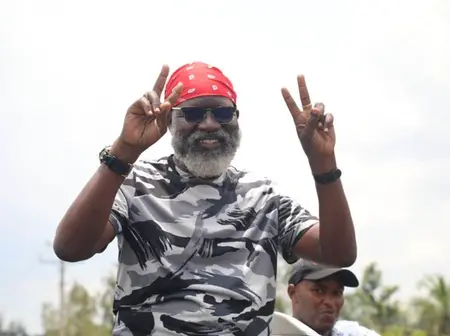
Roots Party leader George Wajackoyah has called for a comprehensive review of government borrowing, public contracts and historical land ownership in Kenya, arguing that the country must confront decisions made since independence to address its economic and social inequalities.
Wajackoyah said Kenya could not properly examine its current financial position without investigating how successive administrations accumulated public debt, entered into government contracts and managed public resources.
Speaking during a morning interview on a local radio station on Thursday, November 12, the 2027 presidential candidate questioned the secrecy surrounding government borrowing, saying Kenyans should have an opportunity to examine and contribute to major financial decisions before they are implemented.
“We shall have to look into all those contracts that the government has signed. Right from independence,” Wajackoyah said.
He argued that the review should extend to the country’s fiscal policy, public financial management and constitutional framework, particularly the involvement of citizens in decisions made on their behalf.
The Roots Party leader said Kenyans should be informed about borrowing plans in advance instead of learning about major financial commitments after decisions have been made.
“We need to see why there is some kind of secrecy when it comes to borrowing. Why aren’t we told in advance so that you can also put an input?” he asked.
Drawing comparisons with the United Kingdom, where he said he had practised law for many years, Wajackoyah argued that public participation should allow citizens to question government projects and expenditure before they proceed.
He cited town hall engagements as an example of how communities could scrutinise proposed projects and express their priorities.
“People can debate, and the bill will be stayed for a while. People can come up and say, no, we don’t need this road. We need this school. Why do we have to?” he said.
He maintained that citizens should have a meaningful opportunity to influence decisions affecting public resources, adding that courts should intervene where disputes or questions about the economic implications of government decisions arise.
The former presidential candidate also called for investigations into historical land allocations and the accumulation of large properties by some families, arguing that the country needed to establish how such disparities emerged.
He questioned why some families own extensive tracts of land while other Kenyans continue to experience poverty.
“We better find out why some families own large tracts of land in this country, whereas some people are very poor,” he said.
Wajackoyah further called for investigations into properties he claimed had been taken unfairly, saying historical injustices should not remain unexamined simply because they occurred many years ago.
His proposal would involve examining inherited public debt, alleged theft of public funds and the circumstances surrounding historical property ownership.
“Look at the debt that was inherited by every president. Look at the monies that were stolen. Look at where we are today,” he said.
He insisted that the country needed to establish what happened before determining how to address the consequences.
He cited Israel’s pursuit of individuals accused of involvement in Holocaust-era atrocities as an example of why accountability should not be abandoned because of the age of a case.
“Nothing is indispensable. Let us dig out. It doesn’t matter how long it will take,” he said.
When asked whether opening up historical records and investigating past decisions could trigger a dramatic political reckoning similar to that associated with Ghana’s former leader Jerry Rawlings, Wajackoyah maintained that Kenya should proceed carefully.
He said the country did not necessarily need to adopt an entire model from another nation but could gradually examine historical decisions and allow citizens to determine the appropriate corrective measures.
“We should go slowly with issues of finding out how we can actually correct ourselves and let the people decide,” he said.
Wajackoyah also proposed that individuals found guilty of wrongdoing should face public accountability through the courts.
“It doesn’t matter if you find me guilty and you put a placard on me through the courts. I was a thief, so that I can walk all over the streets in Nairobi for people to know that I actually stole,” he said.
His proposals place public debt, historical land injustices, government transparency and accountability at the centre of his latest political message as Kenya moves towards the 2027 General Election.
Leave a Reply