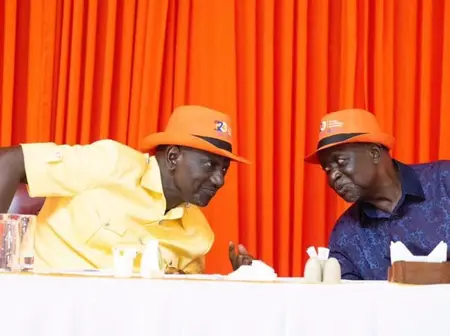
A majority of Kenyans remain opposed to the broad-based government arrangement between President William Ruto and the late former Prime Minister Raila Odinga, with new findings showing that dissatisfaction continues to outweigh support more than a year after the political agreement was announced.
A survey released by TIFA Research on Thursday, November 12, 2026, found that 43 per cent of respondents oppose the arrangement, compared with 32 per cent who support it.
Another 25 per cent either had no opinion or were unaware of the cooperation arrangement between the ruling United Democratic Alliance (UDA) and the Orange Democratic Movement (ODM).
The findings suggest that despite continued political engagements between leaders from the two parties, the arrangement has yet to attract majority support among Kenyans.
The Broad-Based Government was launched following the Gen-Z protests of June 2024, bringing together President Ruto and Raila in an agreement aimed at cooperation and addressing concerns raised during the demonstrations.
TIFA’s latest findings show that support for the arrangement has remained relatively stable in recent surveys, while opposition has declined.
In June 2026, 30 per cent of respondents supported the BBG, while 52 per cent opposed it. In November, support increased slightly to 32 per cent, while opposition fell to 43 per cent.
The research firm observed that “despite this nearly constant level of support over TIFA’s last three surveys, the level of those opposed to it has continued to decline (from 56% to 52% and currently at 43%).”
It also noted that the combined proportion of respondents with no opinion or unaware of the arrangement had returned to 25 per cent, similar to the level recorded in May 2025.
TIFA said it was unclear why the proportion had increased from 18 per cent in June 2026.
The survey revealed significant regional differences in attitudes towards the political arrangement.
Northern Kenya recorded the highest support at 68 per cent, followed by Central Rift at 57 per cent.
Nyanza recorded 38 per cent support, while Coast registered 37 per cent.
The arrangement attracted its lowest support in Mt Kenya, where only 12 per cent of respondents backed it, followed by Nairobi at 13 per cent.
Opposition was particularly high in Nairobi and Mt Kenya, where 57 per cent of respondents in each region said they opposed the arrangement.
TIFA observed that Northern Kenya had consistently recorded the highest support, although the latest survey showed a significant increase from 43 per cent in June 2026 to 68 per cent in November.
The findings come amid growing disagreements within ODM over its relationship with Ruto’s UDA and the party’s political direction ahead of the 2027 General Election.
TIFA linked dissatisfaction among the parties’ traditional support bases, particularly within ODM, to the divisions that have emerged in the longstanding opposition party.
The research firm noted that Nairobi Senator Edwin Sifuna’s presidential bid under the Linda Mwananchi Movement had emerged against this background.
TIFA identified two key demands shaping ODM’s negotiations: the deputy president position and zoning of its political strongholds to prevent UDA and other Kenya Kwanza parties from fielding candidates in those areas.
The research firm also questioned whether the silence surrounding the Ten-Point Agenda launched by Ruto and Raila meant that the reform commitments were being abandoned.
“What position ODM will take if neither of its core election-related demands are met remains to be seen,” TIFA stated.
The latest findings therefore place the future of the Broad-Based Government arrangement under continued public scrutiny as political parties negotiate their positions ahead of the next election.
Leave a Reply