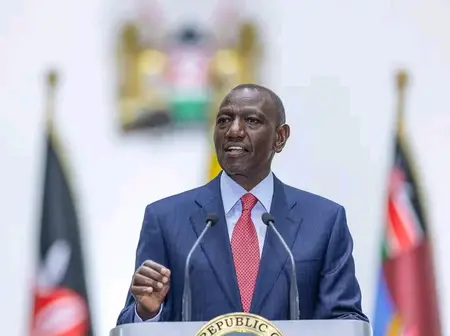
President William Ruto's proposed changes to Pay As You Earn (PAYE) taxation could increase the take-home pay of thousands of Kenyan teachers from January 2027.
The proposal seeks to raise the monthly income tax exemption threshold from KSh24,000 to KSh32,333, allowing workers earning within the new limit to retain more of their salaries.
The announcement has attracted attention among teachers employed by the Teachers Service Commission (TSC), many of whom have expressed concerns about statutory deductions and the rising cost of living.
Ruto announced the proposed tax relief during the 2026 Mashujaa Day celebrations, describing it as part of his administration's efforts to ease the financial burden on salaried Kenyans.
National Treasury Cabinet Secretary John Mbadi subsequently explained the expected financial impact, including how much additional money some workers could retain every month.
Under the proposed arrangement, employees earning KSh32,333 or less monthly would be exempted from PAYE. Currently, the income tax exemption threshold stands at KSh24,000.
Mbadi explained that an employee earning KSh32,333 could save approximately KSh2,083 in monthly PAYE deductions if the proposal is approved and implemented.
For teachers whose taxable earnings fall within this bracket, the exemption could provide additional money for household expenses, transport, food and other essential needs.
The Treasury estimates that approximately 362,846 additional formally employed Kenyans would benefit from the proposed changes. This would increase the number of workers exempted from PAYE from approximately 1.33 million to 1.69 million.
The government estimates that Kenya has about 3.47 million formally employed workers, making the proposed adjustment a significant change to the country's income tax structure.
Another example of the potential benefits was provided by Kenya Bankers Association Chief Executive Raimond Molenje, who discussed a teacher earning KSh60,000 monthly.
Molenje used a five-percentage-point adjustment to illustrate how a teacher earning that amount could potentially gain an additional KSh3,000.
However, this was an illustrative calculation and not a confirmed increase in take-home pay for every teacher earning KSh60,000. The actual benefit will depend on the final tax provisions and an employee's taxable income.
The proposed changes come amid continued discussions about teachers' salaries and deductions. In June 2026, TSC explained adjustments to PAYE deductions following corrections to its payroll system to ensure compliance with existing tax requirements.
The commission attributed the adjustments to a payroll configuration issue involving the treatment of certain statutory contributions.
Meanwhile, the latest PAYE proposal is not a salary increment. Instead, it is a proposed tax adjustment that could allow eligible employees to retain a larger portion of their existing earnings.
The Treasury is expected to prepare the necessary legislative proposals for consideration by Parliament. The government is targeting January 2027 for implementation, subject to the completion of the legislative process.
Teachers will therefore be watching closely as Parliament considers the proposal and the Treasury provides further clarification on how different salary brackets will be affected.
If approved, the new tax arrangement could offer meaningful relief to lower-income teachers and other salaried workers struggling with the rising cost of living.
For educators across the country, the key issue will be how much of their monthly earnings they will finally retain once the proposed PAYE changes take effect.
Source
Leave a Reply