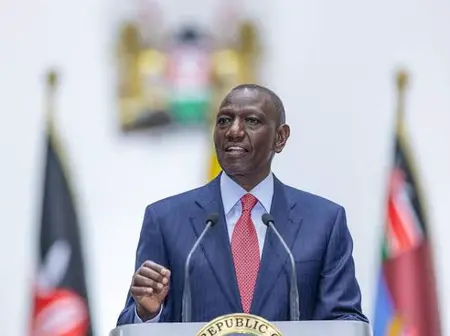
The President said the government plans to merge primary and junior school capitation into a single funding framework, allowing comprehensive schools to operate under one funding arrangement.
Ruto made the announcement on Thursday, November 12, 2026, while addressing the Kenya Comprehensive School Heads Association (KESSHA) National Annual General Meeting in Mombasa.
He explained that the government was reviewing the existing capitation rates to ensure schools receive sufficient resources despite rising operational costs and inflation.
The President directed the Ministry of Education, the Teachers Service Commission (TSC) and teachers' unions to work together and reassess the amount allocated to each learner.
He also instructed Education Cabinet Secretary Julius Ogamba and the TSC to prepare a report by January 2027, which will guide the government's decision on whether to increase the current allocation.
Ruto observed that the last major review of school capitation was conducted in 2015. Although subsequent adjustments raised the amount from KSh1,400 to KSh2,300 per learner, he said changing economic conditions had created the need for another assessment.
The proposed review could result in additional funding for schools if the government approves an increase following the January report.
Beyond the proposed changes to capitation, Ruto announced that schools would continue receiving government funding before the beginning of every academic term from 2027.
He said the government had already released more than KSh86 billion in capitation during the 2026 school calendar.
The amount was disbursed in three instalments, with KSh44 billion released in January, KSh23.4 billion in April and KSh18.5 billion in August.
According to the President, the advance disbursement arrangement would become a permanent practice rather than a temporary measure.
He said the decision would help head teachers concentrate on classroom activities instead of spending the opening days of each term following up on delayed government payments.
Ruto also addressed concerns surrounding the management of education funds, revealing that a government audit had identified approximately 800,000 non-existent pupils in primary school registers.
Nearly 200 schools were also reportedly found to exist only on paper.
To address the problem, the government is digitising learner records to ensure capitation payments are based on the actual number of children enrolled in schools.
The President maintained that public funds must reach genuine learners rather than being allocated using inaccurate school registers.
He further directed the Ministry of Education to work with KESSHA and submit proposals within 90 days for amendments to the Basic Education Act.
The proposed legal changes will address the governance, staffing and financing of comprehensive schools, providing a clearer framework for their management.
The Ministry's January 2027 report on capitation will therefore be an important step in determining whether primary and junior schools will receive higher allocations under the proposed funding arrangement.
https://www.facebook.com/100046664565790/posts/1870825381149596/?app=fbl
Leave a Reply