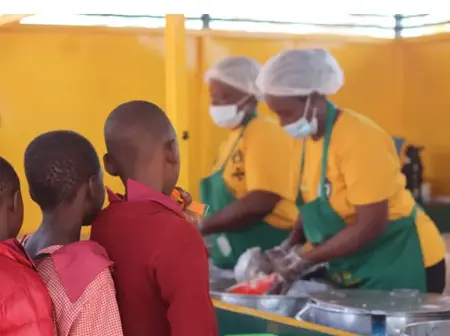
The State Department for Basic Education has warned that millions of vulnerable learners could face interruptions to school meals because of funding shortfall in the next financial year.
The department said the proposed Sh3 billion allocation for the feeding programme was insufficient to sustain the initiative throughout the 2027/28 financial year.
It told the National Assembly Committee on Education that the programme requires Sh8.5 billion to provide meals throughout the 180 school days, leaving a funding deficit of Sh5.5 billion.
In a presentation on the 2027 Budget Policy Statement, Principal Secretary John L. Ololtuaa said the proposed allocation would only sustain the programme for approximately 63 school days, leaving learners without meals for 117 days.
The shortfall threatens the continuity of a programme that targets 2.7 million children, particularly those in arid and semi-arid lands (ASAL), food-insecure regions and pockets of poverty across the country.
The department warned that the school meal is the only reliable source of daily nutrition for some learners and plays a critical role in encouraging school enrolment, attendance and retention.
"The current allocation of Sh3 billion can only sustain meals for about 63 of the required 180 school days, leaving a funding shortfall equivalent to 117 days," the department told MPs.
It added that the funding gap posed a serious risk to programme continuity, particularly among children from vulnerable households who depend on school meals for their daily nutritional needs.
Ololtuaa asked the committee to consider increasing allocations to key underfunded areas, saying additional resources were necessary for the department to fulfil its mandate.
"The areas we have identified as key underfunded areas are critical to the achievement of our mandate. We therefore request your consideration," he said.
The PS said the department would prioritise expanding access to education, improving quality and learning outcomes, strengthening inclusion, enhancing teacher capacity and modernising education service delivery in the 2027/28 financial year.
Kenya's school feeding programme provides daily meals to learners in public early childhood and primary schools, with particular attention to vulnerable communities.
The initiative dates back to early interventions such as the 1979 school milk distribution programme, popularly known as Maziwa ya Nyayo, and World Food Programme support in ASAL regions and informal settlements.
The government assumed full ownership of schools previously supported by WFP in 2018.
Leave a Reply