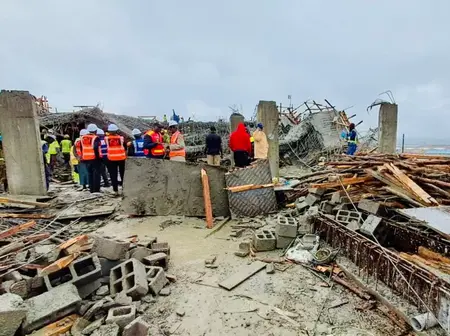
The Institution of Engineers of Kenya (IEK) has called for nationwide safety audits of construction projects following successive building-related tragedies in Syokimau and Riverside that have reportedly claimed at least nine lives.
The institution said the incidents, which occurred on November 13 and 14, respectively, exposed persistent weaknesses in the construction sector.
It warned that the country could no longer afford to respond to building disasters with condolences and promises without addressing underlying safety failures.
The latest incidents came less than a month after an Eastleigh building collapsed on October 23.
In a statement, IEK expressed concern over the growing loss of lives, saying systemic weaknesses in engineering design, construction practices, professional supervision, inspection and regulatory enforcement continued to put workers and the public at risk.
"Enough is enough. As a nation, we cannot continue counting casualties, issuing condolences and making promises while systemic weaknesses in the construction sector remain unaddressed," the institution said.
IEK said it had deployed structural engineers to the sites immediately after the incidents to assess the situations and support emergency response and rescue operations.
The institution also conveyed condolences to families who lost their loved ones and wished those injured a speedy recovery, while commending emergency teams involved in rescue and recovery efforts.
On the Syokimau incident, IEK said preliminary technical assessments pointed to the need to investigate the temporary structures supporting the concrete slab, including formwork, falsework and vertical props.
Investigators should also examine the design and inspection of the temporary support structures before concrete was poured, as well as the procedures followed during concrete placement.
For the Riverside incident, the institution said investigations should focus on the support system for the excavation and retaining walls, which reportedly failed during construction.
However, IEK cautioned against premature conclusions, saying the observations were preliminary and that responsibility should only be established through independent investigations.
"These are preliminary technical observations, not conclusions on cause or responsibility. Accountability must be based on independent, evidence-based investigations," the statement added.
The engineers called on the National and County Governments, National Construction Authority (NCA), Engineers Board of Kenya (EBK), Directorate of Occupational Safety and Health Services and National Building Inspectorate to conduct transparent and comprehensive investigations into the two incidents.
They also demanded that work in affected areas remain suspended until safety clearance is granted and that appropriate action be taken against individuals found culpable of negligence, professional misconduct or violating statutory requirements.
IEK further wants developers compelled to engage registered professional engineers to oversee projects from design through construction until occupation certificates are issued.
It also called for strict enforcement of occupational safety requirements, provision of personal protective equipment and employment of skilled workers at construction sites.
The institution urged authorities to conduct coordinated, risk-based inspections of high-risk construction projects countrywide and undertake a national review of construction safety regulations, inspection and enforcement mechanisms.
IEK warned developers, contractors and building owners against cutting corners, insisting that all construction projects must comply with legal, regulatory and technical requirements.
It also directed members whose professional engagement on a project ends before construction is complete to notify NCA, EBK and the relevant county government to prevent construction from proceeding without professional supervision.