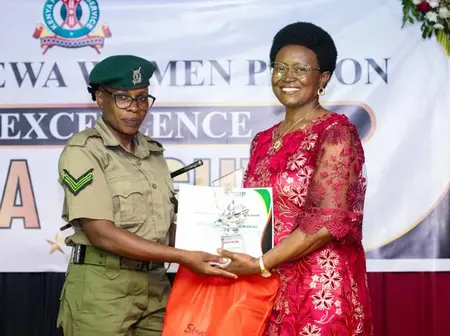
For 17 years, Sergeant Tabitha Wanjau has helped rehabilitate inmates she had never met before, welcoming them with warmth and teaching them skills to help them rebuild their lives after prison.
A certified tailor, Wanjau teaches inmates how to sew, a skill she says comes in handy when they complete their sentences and return to society.
“I always work for the good of humanity and in most cases under minimal supervision. I love my work,” she says.
What Wanjau did not know was that someone had been watching and appreciating her dedication.
She was therefore surprised when her name was announced as the winner of the Shimo la Tewa Women Prison Staff of the Year 2026 award on Friday at the Peacock Hotel in Mzambarauni, Mtwapa.
Though elated, the 42-year-old says the journey has not been easy and credits God for the recognition.
“Our work is not easy. You have to sacrifice. You have to perform your duties to the best of your abilities without complaining, even if the conditions are not the easiest,” she says.
She likens her work to running a home, saying prison officers must lead by example if they expect inmates to change.
“As a parent, there are things you do that mentor the children. Our clients look up to us. So, if you don’t want to work, even the inmates will not work when you tell them to.
“We are their role models. And that is how we help change their behaviours,” she says.
Wanjau says dealing with inmates requires patience because they come from different backgrounds, regions and age groups. Some are much older than her, including women old enough to be her mother, a situation she sometimes finds awkward.
However, she insists that conviction does not take away a person's humanity or right to dignity and respect.
“You need to show them love. We try to rehabilitate them by talking to them, mentoring them, and encouraging them. It is not easy to be an inmate,” she says.
She says prison officers also face challenges arising from society's perception of them as unfriendly.
“We are just human beings like them and we even work closely with them. I don’t know where this notion that police officers are not people’s friends came from,” she says.
She draws a parallel between this stigma and the rejection formerly convicted inmates face after release, saying society must change its attitude towards them.
“These are people who might have done wrong or may have only been victims of circumstances.
“They are not monsters, but human beings just like the rest of us. We need to show them love both in prison and in society when they are released,” she says.
Wanjau says rehabilitation is also a learning experience for officers, noting that some inmates possess valuable knowledge and skills.
“They may give you some vital business tips, which you can implement and be a successful businessperson,” she says.
She believes anyone can find themselves in prison under circumstances beyond their control.
“I am open-minded and wary of the circumstances I am in always. Because I believe even I may find myself in prison, God forbid,” the married mother of two says.
Balancing work and family is another challenge, compounded by threats from inmates who sometimes promise to deal with her after their release.
“I have been threatened many times by the inmates, who say they will deal with me when they get out, but we are used to them. For 17 years, I know how they talk but nothing has ever happened to me,” she says.
Commissioner General of Prisons Patrick Aranduh said the Kenya Prisons Service goes beyond safe custody to rehabilitate offenders and prepare them for successful reintegration into society, despite challenging working conditions.
In a speech read on his behalf by Deputy Commissioner General of Prisons Jane Kirii, Aranduh said excellence was a continuous commitment to service to humanity.
Kirii said the awards, initiated last year by Shimo la Tewa Women Prison officer-in-charge Evelyn Kaliti, recognise staff efforts and boost morale. She urged officers to remain committed to their duties.
“To whom much is given, much is expected,” she said, calling on staff to support Kaliti in making the facility more humane and welcoming.
Kaliti, who also received a surprise award, described staff as the institution's greatest asset, saying their dedication, professionalism and teamwork underpin its achievements.
“When we recognise excellence, we inspire excellence. When we appreciate our people, we strengthen our institution,” she said.
Prof Jostinah Mwang’ombe, head of Shimo la Tewa Borstal Institution and Boys Education Centre, said the awards boost officers' self-esteem, while Coast deputy regional prisons commander Benson Lomeri said Shimo la Tewa Women Prison was the only one among the region's 15 prison stations conducting the initiative.