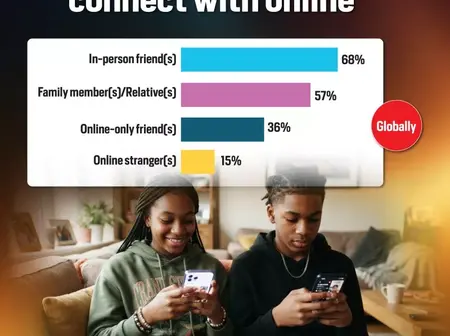
Young people globally most frequently connect online with people they already know offline, led by in-person friends at 68 per cent.
Family members and relatives rank second at 57 per cent, showing that household and extended kin ties play a major role in youth digital interactions worldwide.
Connections formed exclusively online are less common than offline relationships, though they remain a notable share of youth activity.
Globally, 36 per cent of young people connect online with online-only friends. Interactions with online strangers sit at the lowest level among the tracked groups, standing at 15 per cent.
Together, the global figures show a clear hierarchy in how young people engage digitally, moving from 68 per cent for in-person friends and 57 per cent for family members or relatives down to 36 per cent for online-only friends and 15 per cent for online strangers.
Offline acquaintances and relatives account for higher shares than purely digital connections or unfamiliar users across the globe.
Dating and relationships are an important part of life. They give people an opportunity to connect, share experiences, learn about one another, and build meaningful bonds. Whether you are single, casually dating, or in a committed relationship, finding love and maintaining a healthy connection can be an exciting journey. However, successful relationships do not happen by chance. They require effort, understanding, patience, and commitment from both partners.
So, what makes a relationship successful, and how can you enjoy your dating life while building meaningful connections?
One of the most important ingredients in a successful relationship is good communication. Partners should feel comfortable expressing their thoughts, feelings, needs, and concerns without fear of being judged.
Honest conversations help prevent misunderstandings and build trust. It is also important to listen carefully rather than simply waiting for your turn to speak. When both partners communicate openly, they create a safe space where they can understand and support each other.
Trust is the backbone of any healthy relationship. Without it, insecurity, jealousy, and unnecessary arguments can easily develop.
Be honest with your partner, keep your promises, and avoid hiding things that could damage your connection. Remember that trust takes time to develop, so be patient with one another. A successful relationship allows both individuals to feel secure, respected, and appreciated.
No two people are exactly alike. You and your partner may have different interests, opinions, personalities, and backgrounds. Instead of trying to change each other, learn to appreciate those differences.
Respect means valuing your partner's opinions, personal space, decisions, and individuality. A healthy relationship should allow both people to grow while remaining true to themselves.
Dating should not stop being exciting just because you have been together for a long time. Small romantic gestures can make a big difference.
You do not always need expensive gifts or luxurious dates to make your partner feel special. Sending a sweet message, planning a surprise, cooking together, going for a walk, or simply spending quality time together can strengthen your connection.
Never underestimate the power of showing appreciation and making your partner feel loved.
Disagreements are normal in every relationship. What matters most is how couples handle them.
Avoid insults, unnecessary blame, silent treatment, and bringing up past mistakes during every argument. Instead, focus on understanding the problem and finding a solution together.
Remember that you and your partner are on the same team. The goal should not be to win an argument but to understand each other and strengthen the relationship.
Being in love does not mean losing yourself. A healthy relationship gives both partners room to pursue their dreams, hobbies, friendships, and personal goals.
Continue investing in your personal development and happiness. Spend time with friends, explore your interests, and work towards becoming the best version of yourself.
When two people have fulfilling individual lives, they can bring more happiness, confidence, and positive energy into their relationship.
Dating should be an enjoyable experience, not a stressful competition or a desperate search for approval. Whether you are looking for a serious relationship or simply getting to know new people, here are some practical tips to make the experience more fulfilling.
1. Be Yourself: Do not pretend to be someone you are not just to impress another person. Authenticity attracts people who appreciate you for who you truly are.
2. Know What You Want: Understand your values, expectations, and relationship goals. Knowing what you want makes it easier to identify someone whose intentions align with yours.
3. Do Not Rush Love: Give yourself time to know someone before making serious commitments. Enjoy the process of discovering each other's personalities, interests, and values.
4. Try New Experiences: Make dating fun by exploring new restaurants, attending events, going on nature walks, watching movies, or trying activities you both enjoy. Shared experiences create beautiful memories.
5. Set Healthy Boundaries: Learn to say no when something makes you uncomfortable. Your feelings, personal space, and values deserve respect.
6. Avoid Comparing Your Love Life: Every relationship is different. Do not allow social media, friends, or other people's romantic experiences to make you feel that you are falling behind.
7. Recognise Red Flags: Pay attention to dishonesty, controlling behaviour, disrespect, manipulation, and a lack of accountability. Do not ignore unhealthy behaviour simply because you have developed feelings for someone.
8. Have Fun and Stay Positive: Not every date will lead to a lasting relationship, and that is perfectly fine. Treat dating as an opportunity to learn, grow, meet interesting people, and discover what makes you happy.
A successful relationship is not just about physical attraction or romantic feelings. It is also about choosing someone who supports your growth, celebrates your achievements, respects your boundaries, and stands by you during challenging moments.
Look for a partner who demonstrates kindness, emotional maturity, consistency, and genuine interest in building a healthy connection. Remember that love should bring companionship, encouragement, and peace rather than constant fear, confusion, or emotional exhaustion.
Successful relationships are built through mutual respect, trust, communication, honesty, and consistent effort. While no relationship is perfect, two people who genuinely care about each other can work together to create a loving and supportive partnership.
If you are single, enjoy discovering yourself and meeting new people. If you are dating, take time to understand your partner and appreciate the little moments. And if you are already in a committed relationship, never stop nurturing the connection that brought you together.
Above all, remember that dating should be an enjoyable journey, not a race. Do not settle for less than respect, kindness, and genuine affection. Love yourself, know your worth, keep an open mind, and allow meaningful connections to develop naturally.
The secret to a successful relationship is not finding a perfect person; it is building a healthy, happy, and fulfilling connection with someone who is willing to grow alongside you.
The debate erupted following Cillah's recent sit-down interview with media personality Alex Mwakideu. During the conversation, the Westlands Primary School teacher stated that if George had actually agreed to marry her during their viral August banter, she would have politely declined because she is not ready for marriage.
Netizens immediately flooded X, Instagram, and TikTok to dissect the statement, with many expressing disbelief over the sudden change of tune. Several commenters accused the teacher of trying to rewrite history after spending weeks creating wedding skits and calling herself Mrs. George Ruto online.
A large section of users argued that she would have eagerly accepted any real proposal from the First Family, dismissing her remarks as an attempt to save face. Some critics pointed out that George had already made it clear during his August 25 visit to Westlands Primary School that he had a partner and viewed the exchange strictly as harmless entertainment.
Other social media users took a more lighthearted approach, joking that her viral campaign had quietly shifted from planning a high-profile wedding to claiming she was never ready in the first place. Memes and playful commentary quickly circulated, with fans teasing that she was trying to flip the script months after the hype had cooled down.
However, a segment of Kenyans came to Cillah's defense, agreeing with her reminder that social media skits should never be confused with real-life intentions. Supporters noted that content creators routinely exaggerate scenarios for engagement and praised her for keeping her actual personal life private.
Many defenders also highlighted the positive outcome of the viral moment, reminding critics that the online banter led directly to George Ruto visiting Westlands Primary School. During that visit, he interacted with learners, joined a Grade Three multiplication lesson, and pledged sports equipment and learning resources for the institution.
The fresh wave of reactions comes just days after Charlene Ruto's wedding in Mwanza on November 6 revived the old jokes, prompting fans to tag Cillah in celebratory posts. Having already urged Kenyans to move on from the First Family jokes, Cillah appears focused on her teaching duties and lifestyle content despite the ongoing online chatter.
NoticeThe Kenya High Commission in Canberra, Australia, has issued new guidelines to Kenyans seeking Certificates of No Impediment to Marriage and certified copies of Kenyan marriage certificates.The Kenya High Commission in Canberra, Australia, has issued new guidelines to Kenyans seeking Certificates of No Impediment to Marriage and certified copies of Kenyan marriage certificates.
In mid-October, Peter Munene met a woman in his Ndindiriku Village, Kirinyaga County and fell in love with her. Munene loved the woman so much that for the next two weeks, during which the relationship lasted, they were always together, especially in the evenings, having fun in local entertainment joints.
About one in three young people are turning to artificial intelligence (AI) for companionship, with new research linking the practice to higher levels of loneliness.
A report by Gallup and Boston Children's Digital Wellness Lab, titled Friendship in an Online-Offline World: Digital Life, Connection and Wellbeing Among Young People, found that a median of 33 per cent of young people across 16 countries had used AI as a social companion or friend.
The findings show that AI companionship is more common among frequent users. Half of those who used AI at least once a day said they had turned to it for companionship, compared with 35 per cent of weekly users and 24 per cent of those who used it less frequently.
The trend was also more pronounced among young people with online-only friends. According to the report, 42 per cent of those with an online-only friend had used AI as a social companion, compared with 26 per cent of those without such a friendship.
However, the report raises concerns about the relationship between AI companionship and loneliness.
Young people who reported using AI as a social companion or friend had 70 per cent higher adjusted odds of experiencing higher loneliness than those who did not, after accounting for friendship quality, satisfaction with social time and other characteristics.
The report cautions that the findings do not establish whether AI companionship contributes to loneliness or whether young people experiencing loneliness are more likely to turn to AI.
“These findings are observational and do not establish whether dissatisfaction with social time or AI companionship contributes to loneliness, results from it or reflects other circumstances,” the report states.
The study also found that loneliness was more common among young people who frequently communicated online with strangers or friends they had never met in person.
Among those who frequently communicated one-to-one with strangers online, 42 per cent reported higher loneliness. The figure was 32 per cent among those who frequently communicated with online-only friends.
By comparison, 24 per cent of young people who frequently communicated online with friends they knew in person reported higher loneliness. The same proportion was recorded among those who frequently communicated with family members.
The report defines higher loneliness through feelings of lacking companionship, being left out and feeling isolated.
In-person friendships remained strongly associated with lower loneliness. The proportion of young people experiencing higher loneliness fell from 32 per cent among those with low-quality in-person friendships to 21 per cent among those with high-quality in-person friendships.
Young people whose highest-rated friendship was with someone they had only interacted with online also reported higher levels of loneliness. The figure stood at 43 per cent, compared with 20 per cent among those whose highest-rated friendship was an in-person relationship.
Across the countries surveyed, a median of 93 per cent of young people reported having at least one friend with whom they primarily spent time in person.
In Kenya, 18 per cent of young people reported having an online-only friend. The figure rose to 31 per cent among those with regular access to an internet-enabled device.
The report noted that only 58 per cent of young people interviewed in Kenya met the criteria for regular access to an internet-enabled device.
The researchers said digital spaces provide additional opportunities for young people to form and maintain relationships, but the quality of those relationships and the wider social environment remain important.
The 2026 study surveyed young people aged 15 to 22, including 1,000 respondents in Kenya, where interviews were conducted face-to-face.
A happy relationship is built when both partners understand that love is not just about finding someone who makes them happy, but also becoming someone who brings peace, encouragement and emotional security into the others life.
Real love makes a man reflect on himself.It makes him think about how his words sound,how his actions affect you,and how he can do better.A man who truly loves you doesn't stay comfortable in behavior that causes you pain.
Every man oats to spend his life with a woman who brings him peace but many forget that her peace is a reflection of how you treat her.Being loved is beautiful.But being considered,protected,respected,and understood is a whole different kind of love.
A woman I was seeing with serious intentions about marriage broke up with me, and one reason she gave was that I don't spend enough on her. She called me stingy and said she couldn't feel like a woman if a man is not investing in her.
The government has announced plans to introduce a new digital system that will automate marriage registration, divorce management and adoption services across Kenya.
The project will be implemented at the Office of the Attorney General (OAG), with the Information and Communications Technology Authority (ICTA) managing the procurement process on behalf of the government.
The proposed system will handle registration and management of different types of marriages, including civil, customary, Christian, Hindu and Islamic marriages across all 47 counties.
It will also support customary marriage documentation using forms CM 1 to CM 8, manage divorce cases, process adoption services and handle the licensing of ministers of faith.
According to the project details, the system will be connected to six government platforms to improve service delivery and make it easier to verify information and access official records.
The platforms include eCitizen, Paybill 222222, Integrated Population Registration Services (IPRS), the Registrar of Societies, the Judiciary and the Office of the Attorney General's Electronic Document and Records Management System (EDRMS).
The project is being implemented under the Kenya Digital Economy Acceleration Project (KDEAP), which is financed through loans from the World Bank.
ICT companies interested in developing the system have been invited to submit their bids by January 14, 2027, at 10:00 AM.
Each bidder will be required to provide a bid security of Ksh 2.5 million.
However, the procurement notice has not disclosed when the new platform is expected to become operational or how much the successful bidder will be paid.
The development comes as the Attorney General's office continues to improve marriage services, including the establishment of a VVIP civil marriage lounge.
Currently, couples seeking civil marriage are required to apply through eCitizen and observe a 21-day public notice period before they can solemnise their marriage.
The government has started the process of digitising marriage registration, divorce management and adoption services in a major transformation targeting the Office of the Attorney General (OAG).
The project will see several services currently handled manually moved to a central digital platform, making it easier to manage records and access government services across the country.
The Information and Communications Technology Authority (ICTA) has invited technology firms to submit bids for the development of an integrated back-end system. The proposed platform will handle different marriage registration processes across all 47 counties.
According to a procurement notice issued on Tuesday, November 17, the system will cover civil, customary, Christian, Hindu and Islamic marriages. It will also support documentation of customary marriages through forms CM 1 to CM 8.
Apart from marriage registration, the platform will automate divorce case management, licensing of ministers of faith and adoption services. These functions will be brought together under one system to improve the management of records within the Attorney General's office.
ICTA said the proposed platform would be connected to six existing government systems to allow information to move between different institutions.
The systems include eCitizen, Paybill number 222222, the Integrated Population Registration Services (IPRS), the Registrar of Societies and the Judiciary. It will also connect to the Attorney General's Electronic Document and Records Management System (EDRMS).
The integration is expected to support identity verification, payment processing and access to relevant government records. The two-way connection will allow the different platforms to exchange information rather than operate independently.
The project will be implemented under the Kenya Digital Economy Acceleration Project (KDEAP), which is financed through loans from the World Bank.
ICTA will oversee the procurement process on behalf of the government, with the selected technology company expected to develop the system that will support the digitisation of the services.