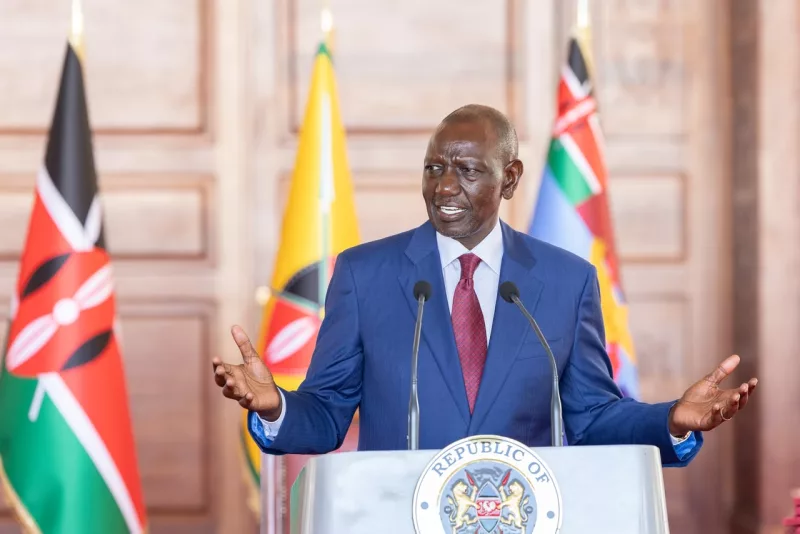
President William Ruto has ordered the establishment of breastfeeding facilities and flexible working arrangements for mothers employed at State House following the signing of the Breastfeeding Mothers Bill, 2024, into law.
Ruto said he would immediately direct State House staff to set up private and decent spaces where women can breastfeed their babies while continuing with their duties.
He also wants working mothers with young children to have flexible schedules to help them balance their professional responsibilities with childcare.
“I will immediately instruct staff in State House to make sure that we become an institution, I know there are those who may be ahead of us, to make sure that in this State House, there are spaces for those who work here, especially for mothers and women who work here, to find decent places for breastfeeding and all the other related activities,” he said.
The President added that mothers should not face unnecessary strain as they combine work with raising children.
“There must be flexibility to allow our mothers to undertake the noble responsibility of bringing up our children but also being able to attend to their work,” he said.
The Breastfeeding Mothers Bill seeks to remove workplace barriers facing breastfeeding women and improve maternal and child health.
The law requires employers to provide clean, private and appropriately equipped lactation spaces. It also provides for reasonable breastfeeding breaks and flexible working arrangements.
It further requires owners, tenants and lessees of buildings accessible to the public, with an occupancy capacity of at least 50 people, to provide baby-changing facilities.
Ruto congratulated MPs who supported the legislation and singled out nominated Senator Sabina Chege, who sponsored the Bill, for her role in pushing it through Parliament.
“Let me congratulate Sabina Chege. I know this piece of legislation has been in Parliament for a while; thank you very much for the push and to all the MPs who supported the Bill,” he said.
The Breastfeeding Mothers Bill was among six pieces of legislation Ruto signed at State House Thursday, November 26.
The other five are the East African Development Bank (Amendment) Bill, 2026; Environmental Professionals Institute of Kenya Bill, 2024; Public Service Superannuation Scheme (Amendment) Bill, 2025; and two Sexual Offences (Amendment) Bills, of 2023 and 2025.
The East African Development Bank amendment strengthens parliamentary oversight of public funds committed to the regional lender. It requires National Assembly approval before money is released from the Consolidated Fund to the bank.
The Environmental Professionals Institute of Kenya law establishes a framework for registering, licensing and regulating environmental professionals. It also provides for professional standards, development and disciplinary processes.
The Public Service Superannuation Scheme amendment changes the management of retirement savings and benefits. Among its provisions is an option for public servants on fixed-term contracts to transfer accrued gratuity into retirement savings accounts.
The two Sexual Offences amendments address different areas of protection. The 2023 legislation provides for nationwide public awareness campaigns on sexual offences and programmes to protect the education rights of victims, including those affected by teenage pregnancies.
The 2025 amendment seeks to ensure sexual offences are handled through formal judicial processes. It provides that agreements or settlements purporting to resolve such offences outside the courts will have no legal effect.
The six laws cover workplace welfare, retirement benefits, environmental regulation, public finance oversight and the handling of sexual offences.