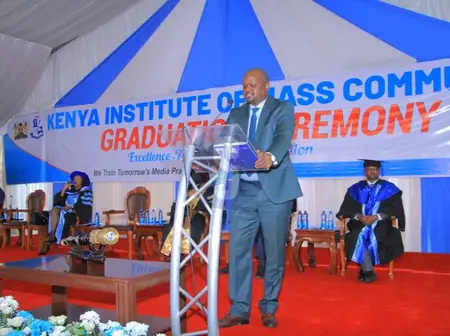
Young professionals have been warned against pursuing quick riches and celebrity status at the expense of integrity, with Radio Africa Group Editorial Director Paul Ilado cautioning that shortcuts to success could undermine their careers and damage their character.
Ilado challenged 498 journalism graduates of the Kenya Institute of Mass Communication (KIMC) to build their careers through patience, hard work, continuous learning and a commitment to excellence.
Addressing the graduands, he said success meant different things to different people. He cautioned against measuring achievement solely through wealth, expensive cars, prestigious addresses or the speed at which one attained public recognition.
"There is a big temptation to choose materialism, so you can get rich quickly, and that, in my opinion, will be one of the biggest challenges you have to deal with," he said.
He warned that the pressure to accumulate wealth and acquire material possessions could push young professionals into compromising their values in pursuit of immediate rewards.
"That road is fraught with a lot of landmines. Those landmines compromise your character, your integrity and your value system. This road displays a poverty of ambition. It puts you on a fast lane to self-destruction," Ilado said.
He urged the graduates to resist a culture that prioritises appearances over substance, celebrity over character and short-term gains over lasting achievements.
"The impression created, the elevation of appearance over substance, of celebrity over character, of short-term gains over lasting achievements is what I'm asking you to avoid," he said.
Ilado said young journalists entering the profession would face different expectations and pressures, particularly in an environment where social media had created opportunities for instant visibility and public recognition.
He challenged them not to confuse popularity with professional achievement or assume that becoming a household name was the only measure of success.
He observed that some graduates might aspire to own expensive cars, live in prestigious neighbourhoods or accumulate substantial sums of money, while others might define success through professional recognition and the opportunity to occupy prominent broadcasting positions.
He cited established media personalities, including Maina Kageni, Giddy and Ghost, and Jeff Koinange, as examples of the professional visibility some young graduates might aspire to attain.
However, he said individual career journeys were different and graduates should establish their own sustainable paths rather than measure themselves against the achievements of others.
Ilado also urged the graduands not to become complacent after completing their studies, saying the certificate was a milestone rather than the conclusion of their professional development.
Using the contrasting experiences of English Premier League clubs Arsenal and Manchester United, he illustrated how even successful institutions could lose their standing when they failed to manage transitions and continuously improve.
He recalled the departures of Arsene Wenger from Arsenal after 18 years and Alex Ferguson from Manchester United, saying the subsequent managerial changes at the clubs offered lessons on the importance of succession planning and maintaining standards.
"The biggest lesson we take from these two teams is that you can be great today, but if you do not continuously improve yourself, you will one day be fighting for your life, let alone your career," he said.
He urged graduates to remain passionate about their chosen professions, nurture their talents and actively seek opportunities to improve their skills.
"It doesn't matter what you've done so far. It will not matter what you will do in the next four or five years of your life. There is always room for you to learn more, to achieve more and to be able to break the glass ceiling," he said.
Ilado said the graduates were entering a fast-paced environment shaped by innovation, critical thinking and creativity, requiring them to take personal responsibility for their professional development.
KIMC Director and Chief Executive Peter Wakoli said the institution had aligned its training programmes with changing demands in the media industry and the creative economy.
He said the 2026 cohort had demonstrated its capabilities through multimedia storytelling, artificial intelligence-assisted content creation and independently run digital platforms.
Wakoli said the institution was committed to producing graduates who could adapt to emerging technologies while maintaining professional standards.
ICT Authority Chief Executive Jessy Maruti also welcomed the graduates, saying their skills would be valuable in improving communication and storytelling.
"I'm looking forward for these graduates to join us so that they can tell the story the way it's supposed to be told," Maruti said.
The 498 graduands completed their studies under the theme of excellence, talent, trust and innovation.
Leave a Reply