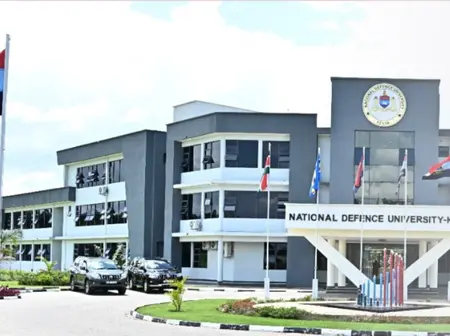
Ever wondered where Kenya trains the people who shape the country’s security and defence decisions? Located in Lanet, Nakuru County, the National Defence University-Kenya (NDU-K) is the country’s first specialised university focusing on defence, national security and strategy.
The university was awarded its Charter on May 27, 2021, under Section 24 of the Universities Act, becoming the first institution of its kind in Kenya. It was gazetted shortly afterwards and officially inaugurated in August 2022.
Its mandate is to provide education, training and research in defence, security and strategy, producing graduates who can contribute to safeguarding the country.
NDU-K brings together seven colleges linked to national security and defence training. They include the National Defence College, Joint Command and Staff College, Kenya Military Academy, International Peace Support Training Centre, Defence Forces Technical College, Defence College of Health Sciences and Defence Intelligence Academy.
Together, the colleges offer more than two dozen accredited programmes, ranging from diplomas and bachelor’s degrees to master’s and doctoral qualifications.
Courses on offer include a Bachelor of Science in Defence and Security Studies, Bachelor of Science in Nursing with Military Health, Bachelor of Science in Information Technology for Defence Systems, Master of Arts in National Security and Strategy, Master of Arts in Crisis Response and Disaster Management and a PhD in National Security and Strategy.
The university is also working towards introducing additional programmes, including advanced courses in intelligence and engineering.
Yes, although access depends on the programme. According to the university’s admission information, courses offered at the International Peace Support Training Centre are open to non-military applicants, including members of the public and staff from ministries, departments and agencies.
Most other programmes, however, prioritise serving members of the military and government security agencies.
Admission is handled by the university Senate, which considers applications against the academic and other requirements set for individual programmes. Applicants must therefore meet the qualifications for their preferred courses.
This means that ordinary Kenyans interested in joining the institution need to establish which programmes are open to civilians before applying.
Interested applicants can begin the process through the university’s online application portal at https://apply.ndu.ac.ke.
Prospective students are required to create an account and validate their email address before proceeding to complete the application.
Those seeking clarification on available courses, admission requirements and application procedures can contact the admissions office through admissions@ndu.ac.ke.
Fees are determined by the University Council and vary depending on the programme.
Interested applicants can also access the university’s services through its eCitizen portal at https://ndu.ecitizen.go.ke/. The platform provides services including academic records, transcripts, certificates and tuition fee payments.
Since civilian admission is limited to selected courses, prospective students are encouraged to check the university’s official website regularly for updated admission notices and details of programmes open to the public.
For Kenyans interested in peace support, disaster management and related areas of national security, the International Peace Support Training Centre provides an opportunity to pursue specialised training at the university.
Leave a Reply