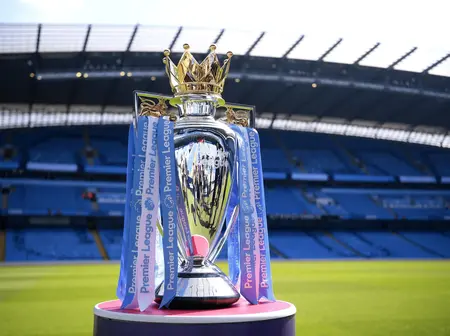
For much of the Premier League's early history, a handful of clubs appeared to have a firm grip on the title. Manchester United dominated under Sir Alex Ferguson, Arsenal emerged as serious challengers under Arsène Wenger, and Chelsea joined the elite after Roman Abramovich's takeover in 2003.
The numbers from that era tell an interesting story. Manchester United won the 1996/97 Premier League title with just 75 points. Almost three decades later, teams have regularly needed totals approaching 100 points to secure the same trophy.
The competition has changed considerably. Financial investment, improved recruitment, tactical development and the growing strength of rival clubs have raised expectations across the division. For today's leading sides, winning the Premier League requires more than having the best players. It demands consistency over an increasingly unforgiving 38-game campaign.
Manchester United's title-winning squad during the 1996/97 season.
The 1996/97 season offers a useful starting point when examining how the Premier League has evolved. Manchester United finished top with 75 points, despite losing eight matches. Newcastle United, their closest challengers, finished with 68 points.
Fast-forward to 2017/18, and Manchester City produced one of the most remarkable campaigns in English football history. Pep Guardiola's side collected 100 points, winning 32 of their 38 matches and losing just twice.
City's achievement also changed expectations. Liverpool finished second in 2018/19 with 97 points, a total that would have been enough to win every previous Premier League season except one. Yet Manchester City still finished ahead of them with 98 points.
The following season, Liverpool finally claimed the title with 99 points, having lost just three matches.
These campaigns showed how demanding the top-of-the-table race had become. A team could enjoy an outstanding season, accumulate more than 90 points and still have nothing to show for it.
However, the points requirement is not a fixed target. Liverpool won the 2024/25 championship with 84 points, showing that title races can still be decided with considerably lower totals. What has changed is the level of competition capable of pushing champions towards extraordinary performances.
A four-panel football graphic featuring the logos of Chelsea, Arsenal, Liverpool, and Manchester United.
For years, Manchester United, Arsenal, Chelsea and Liverpool were regarded as the Premier League's leading title contenders. Their financial resources, established reputations and ability to attract top players gave them significant advantages.
That landscape has become more complicated.
Manchester City's rise under Guardiola introduced another dominant force, while Newcastle United's new ownership has increased their ambitions. Aston Villa have also demonstrated that clubs outside the traditional elite can challenge for Champions League qualification and disrupt the established order.
The 2023/24 campaign provided a particularly good example. Manchester City finished champions with 91 points, just two ahead of Arsenal. Liverpool were third with 82 points, while Aston Villa secured fourth place with 68.
The gap between the leading clubs and the rest remains significant, but the competition for points is no longer restricted to a handful of familiar opponents.
Teams such as Brighton, Brentford and Bournemouth have also developed recognisable playing identities and become difficult opponents, particularly when facing clubs that expect to dominate possession.
For title contenders, this means there are fewer opportunities to recover from disappointing results.
Manchester City celebrate their historic 2017/18 Premier League triumph after becoming the first team to reach 100 points in a single season.
Any discussion about the modern Premier League title race would be incomplete without examining Manchester City's influence.
Guardiola arrived in England in 2016 and gradually built a team capable of controlling matches through possession, intelligent positioning and relentless attacking pressure.
His first Premier League title came in 2017/18, when City collected 100 points. They followed it with another championship in 2018/19, finishing on 98 points.
The club subsequently won four consecutive Premier League titles between 2020/21 and 2023/24, becoming the first side to achieve that feat in the competition's history.
Their sustained success placed enormous pressure on rival clubs.
Liverpool, under Jürgen Klopp, were among the few teams capable of matching City's consistency. The two sides produced extraordinary title contests, particularly in 2018/19 and 2021/22.
In the latter season, City finished with 93 points, just one ahead of Liverpool.
Pep Guardiola and Jürgen Klopp share the touchline during the intense rivalry between Manchester City and Liverpool.
These rivalries demonstrated that winning the Premier League increasingly required teams to maintain exceptional standards throughout the season. Dropping points in seemingly manageable fixtures could prove decisive.
Money has always played an important role in football, but the modern Premier League has become an increasingly sophisticated marketplace.
Clubs invest heavily in scouting networks, sports science, data analysis, coaching facilities and player development. Recruitment departments also have access to more detailed information when identifying players who fit specific tactical systems.
For the biggest clubs, assembling a competitive starting eleven is only part of the challenge. Maintaining quality across the entire squad is equally important.
The demands of European competitions make this particularly significant. Teams competing in the Champions League must balance domestic fixtures with demanding continental schedules, often playing several matches within a short period.
Injuries, suspensions and fatigue can quickly expose weaknesses in squad depth.
Tactical development has also made Premier League matches more demanding. Opponents are increasingly comfortable using high pressing, compact defensive structures and quick transitions to disrupt stronger sides.
Consequently, established clubs cannot simply rely on their reputation or individual quality to secure victories.
Consistency has become one of the most important characteristics of a Premier League champion.
The 2023/24 campaign illustrated this perfectly. Manchester City, Arsenal and Liverpool spent much of the season competing for the top position, with the title race remaining open deep into the campaign.
Arsenal finished with 89 points, Liverpool collected 82, while City secured the championship with 91.
The final Premier League table for the 2023/24 season, showing all 20 clubs and their positions, matches played, goal difference and points.
Arsenal's 89-point total was impressive, but it was not enough to end their wait for another Premier League title.
The campaign also demonstrated how quickly the situation can change. Liverpool suffered a home defeat against Crystal Palace, while Arsenal lost to Aston Villa in the same April weekend. Those results helped shift the advantage towards Manchester City.
For clubs competing at this level, a few disappointing afternoons can have enormous consequences.
Managers must therefore find ways to maintain performance levels despite injuries, fixture congestion, changes in form and the pressure of competing for silverware.
There is little room for extended losing streaks or repeated draws.
The Premier League remains one of the most competitive domestic football competitions in the world, and its evolution has made the title increasingly difficult to secure.
The dominance of Manchester United in the 1990s and early 2000s belonged to a different competitive environment. Today, established clubs face stronger challengers, greater tactical sophistication and increasingly demanding expectations.
Manchester City's achievements have helped redefine what consistency looks like, while the challenges from Liverpool, Arsenal and other ambitious clubs have made the race more unpredictable.
Ultimately, winning the Premier League is no longer simply about having the strongest starting eleven or the biggest collection of superstars.
It requires intelligent recruitment, squad depth, tactical flexibility and the ability to deliver results when the pressure is highest.
For even the biggest clubs, that combination is becoming increasingly difficult to maintain over an entire season.
Leave a Reply