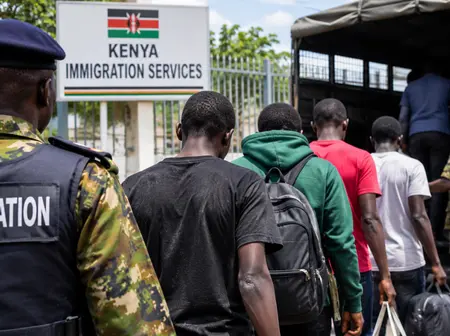
Arrests of Nigerian nationals in Kenya increased sevenfold in the year to August 2026, rising from three to 24, even as the overall number of undocumented foreign nationals arrested in the country grew by 10 per cent.
The figures, contained in the 2025/2026 Annual Report on the State of National Security, show sharp increases in arrests involving Nigerians, Eritreans, Somalis and Tanzanians, while arrests of Ethiopian nationals declined.
Kenyan authorities recorded 1,048 arrests of undocumented foreign nationals between September 2025 and August 2026, compared with 953 in the previous reporting period. The increase of 95 arrests represents a 10 per cent rise.
Nigerian nationals recorded the largest percentage increase among the nationalities listed, with arrests rising from three to 24, a 700 per cent jump.
Arrests involving Eritreans increased from 74 to 126, representing a 70.3 per cent rise, while those involving Somalis grew from 90 to 156, an increase of 73.3 per cent. Tanzanian arrests rose from nine to 25, a 177.8 per cent increase.
Despite the increases involving other nationalities, Ethiopian nationals continued to account for the largest share of arrests.
The report recorded 592 Ethiopian nationals arrested during the latest reporting period, representing 56.5 per cent of the total. This was down from 670 in the previous year, an 11.6 per cent decline.
Arrests involving Burundian nationals also fell, from 69 to 50, while those involving Egyptian nationals dropped from 11 to one.
The government says Kenya continues to experience a “significant influx of undocumented immigrants and irregular migrants” fleeing conflict, political instability and economic hardship in the region.
In describing the challenge, the report states that the movement of undocumented individuals across points of entry “directly undermines Kenya’s national security”.
However, the figures do not explain why arrests involving some nationalities increased while those involving others declined. Nor do they establish whether the changes resulted from shifting migration routes, intensified enforcement or improved detection.
The report records arrests, not the total number of people entering or living in Kenya without regular immigration status.
The government says it has strengthened border surveillance and established the Counter Organised Immigration Crimes Unit within the National Police Service to support efforts against organised immigration-related crime.
Other measures include intelligence-sharing with neighbouring countries, cooperation with diplomatic missions to verify identities and the involvement of border communities in reporting suspected human smuggling and trafficking networks.
The report says authorities have intensified the identification, arrest, prosecution, repatriation and deportation of undocumented migrants in accordance with the law and applicable international obligations.
Despite these measures, it acknowledges continuing weaknesses, including “border management deficiencies”.
It also points to “the increasing sophistication of transnational organised criminal networks involved in human trafficking, migrant smuggling and document fraud” as a major challenge.
The report further identifies “limited public awareness and community cooperation” as obstacles to tackling the problem.
The nationality-specific figures raise questions about where enforcement operations were concentrated and whether migration patterns changed during the reporting period.
For Nigerians, the increase from three arrests to 24 is a sharp percentage rise, but the actual number remains relatively small. It should not be interpreted as evidence that Nigerian migration into Kenya increased by 700 per cent.
Similarly, the decline in Ethiopian arrests does not necessarily mean fewer Ethiopian nationals entered the country irregularly. The report provides no figures on the total number of migrants entering Kenya by nationality.
The government says it plans to introduce modern border management technologies, strengthen regional cooperation and improve the processing of asylum applications and migration cases.
It also commits to reviewing the legal and policy framework governing immigration, asylum and border management to address emerging migration trends.
But the report does not explain what drove the contrasting changes in arrests by nationality.
Further information from the National Police Service and the Directorate of Immigration Services on arrest locations, reasons for interception, suspected migration routes and case outcomes would help establish what lies behind the figures.
For now, the report provides a record of enforcement activity, rather than a complete picture of undocumented migration into Kenya.
Leave a Reply