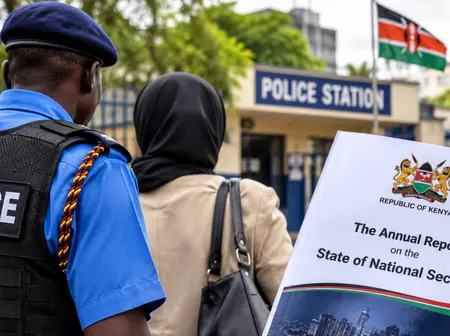
Kenya’s actual crime levels could be significantly higher than official statistics indicate, with a new government security report admitting that public mistrust of law enforcement agencies is discouraging victims from reporting offences.
The 2026 Annual Report on the State of National Security warns that weak community confidence in security agencies, fragmented investigative records and inadequate forensic capabilities are undermining the country’s fight against crime.
In one of its most significant admissions, the report says public mistrust continues to suppress crime reporting, meaning official statistics do not capture the full extent of criminal activity.
The government acknowledges that the reported figures “understate actual incidence by an unquantified margin.”
The revelation raises questions about how many crimes go unreported, why victims lack confidence in security agencies and whether the government can accurately assess insecurity without reliable reporting and investigation systems.
The report covers the period between September 2025 and August 2026.
Kenya recorded 97,946 criminal cases during the reporting period, compared with 97,366 in the previous year, representing an increase of 580 cases, or 0.6 per cent.
The figures include 2,814 homicide cases, 3,549 robberies, 4,655 economic crimes and 5,180 cases of criminal damage.
Dangerous drug-related offences accounted for 6,949 reported cases, while corruption cases stood at 80.
However, the government cautions that these figures should not be interpreted as the full extent of crime because mistrust between communities and law enforcement agencies discourages reporting.
The report identifies this problem as a major constraint to effective enforcement of law and order.
It also records 248 offences involving police officers, compared with 237 in the previous reporting period. However, it does not clarify whether these were offences committed by officers, against officers or other cases involving them.
The figures therefore do not establish that 248 police officers were implicated in criminal activities.
Beyond underreporting, the report identifies weaknesses in the systems used to investigate and track criminal cases.
It says records remain fragmented and substantially paper-based, contributing to cases being lost or abandoned during the investigative process.
The government also acknowledges that forensic and digital evidence capabilities have not kept pace with the demands of modern investigations.
These shortcomings could undermine efforts to secure convictions, particularly as criminal activities increasingly involve digital platforms and sophisticated networks.
To address the problem, the government plans to introduce integrated databases covering Occurrence Book records, forensic information and case tracking across security agencies.
It also intends to train officers in digital evidence handling and strengthen investigative capacity through cooperation with higher learning institutions and development partners.
The report further identifies fast-tracking pending investigations as a priority for rebuilding public confidence in law enforcement.
One of the report’s strongest observations concerns how the government measures its performance in fighting crime.
It acknowledges that security agencies frequently report activities such as arrests, operations and police deployments without adequately demonstrating the outcomes achieved.
“The Report is consequently better able to say what was done than what was achieved.”
It recommends tracking criminal cases from initial reporting through to charging and conviction, arguing that successful disruption of criminal enterprises matters more than the volume of arrests.
The government states that “disruption of criminal enterprise, not volume of arrest, is the measure that matters.”
This admission raises questions about the effectiveness of security operations where arrests are announced, but the subsequent progress of investigations and prosecutions is not clearly established.
The report recommends standardising data collection across government agencies and improving the tracking of cases to provide a more reliable picture of criminal justice outcomes.
The government says it is pursuing reforms to improve policing, strengthen accountability and restore confidence between communities and security agencies.
Among the measures outlined are revitalising community policing, increasing public engagement and fast-tracking proposed security legislation.
However, the report acknowledges that most security-sector reforms remain at different stages of development, with few having been enacted.
It also warns that the 2027 General Election will place additional pressure on the country’s security institutions as political competition intensifies.
Party primaries, boundary reviews and voter registration are identified as potential flashpoints, particularly given the continuing threat of politically mobilised criminal groups.
Ultimately, the report presents a challenge extending beyond police numbers and security operations.
Kenya must address the mistrust discouraging crime reporting, strengthen investigations and demonstrate that reported offences result in meaningful criminal justice outcomes.
Without reliable reporting and effective investigations, the government risks fighting crime with an incomplete picture of the insecurity affecting the country.
Leave a Reply