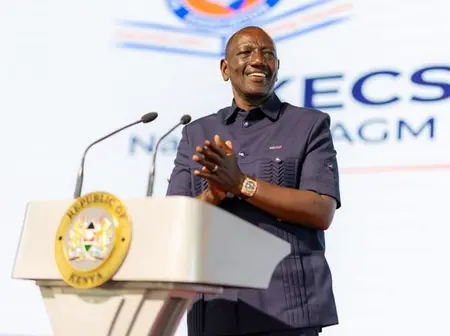
President William Ruto has announced that Kenya printed national examination papers locally for the first time in 65 years, highlighting the development during his State of the Nation Address at Parliament on Wednesday, November 18, 2026.
Ruto said the local production of examination papers was among the changes in the education sector, as candidates across the country continued sitting the 2026 Kenya Certificate of Secondary Education (KCSE) and Kenya Junior School Education Assessment (KJSEA).
“For the first time in 65 years, examination papers were printed here in Kenya,” Ruto told a joint sitting of the National Assembly and Senate.
The president also addressed the security arrangements during this year’s examinations, saying candidates had completed their papers without police officers being deployed at examination centres.
“We have currently undertaken examinations without the presence of a single policeman. This is how it should be, examinations are a normal part of learning, not a security operation,” Ruto said.
His remarks came as more than one million KCSE candidates sat Geography Paper 2 in the morning and Physics Paper 2 in the afternoon.
The president said the examinations had been conducted in a calm and orderly atmosphere, contrasting the current arrangements with previous examination seasons when security officers were deployed at centres.
The government has maintained that examination security measures should protect the integrity of national assessments without creating an intimidating environment for learners.
The 2026 KCSE examinations began with oral, practical and low-candidature papers on October 19, while the main written examinations started on November 2.
According to the Kenya National Examinations Council (KNEC) timetable, candidates sat Geography Paper 2 from 8 am to 10.45 am on Wednesday, followed by Physics Paper 2 between 2 pm and 4 pm.
The examination period is scheduled to end on Friday, November 20, with candidates sitting Physics Practical.
This year’s KCSE examinations have attracted 1,048,355 candidates, the highest number in the history of the assessment.
Education Cabinet Secretary Julius Ogamba said the figure represented a 5.27 per cent increase from the 995,860 candidates registered in 2025.
The candidates are sitting their examinations in more than 10,000 centres across the country, requiring the deployment of thousands of personnel to oversee the exercise.
KNEC planned to engage 10,765 centre managers, 12,274 supervisors, 57,432 invigilators and 21,388 security officers during the examination period.
The council also introduced integrity measures, including restrictions on mobile phone use by candidates and examination personnel, to prevent examination irregularities.
The 2026 KCSE candidates form the second-last cohort under the 8-4-4 education system, with the final group expected to sit the examinations in 2027 as the country completes its transition to Competency-Based Education (CBE).
The transition has also brought changes to the assessment of learners in junior school, with the Kenya Junior School Education Assessment (KJSEA) forming part of the new education framework.
Ruto’s address brought attention to the administration of both KCSE and KJSEA examinations, particularly the local printing of papers and changes in security arrangements.
The examination season has also faced challenges, including reports of candidate deaths, absenteeism in some areas and concerns raised earlier over payments for teachers involved in administering the tests.
With the KCSE examinations approaching their conclusion, the President used the local printing milestone and the conduct of the assessments to highlight developments in the country’s examination system.
Leave a Reply